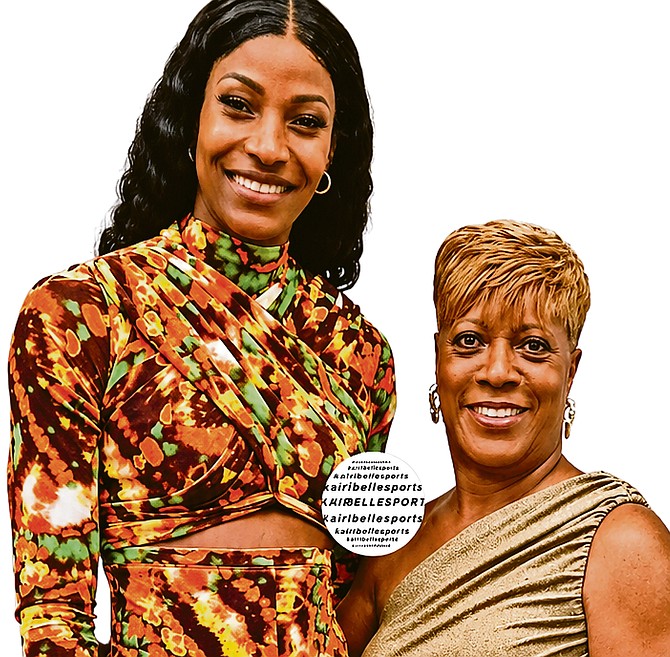
Bahamian two-time Olympic champion Shaunae Miller-Uibo with NACAC Gender Leadership Committee chairperson and World Athletic Council Member Donn
By CLAYTON CLARKE
caribbeanathleticsmedia@gmail.com
PROVIDENCIALES, Turks and Caicos Islands: Two-time Olympic women's 400m champion Shaunae Miller-Uibo says for women to succeed in sports they must be given the same opportunities as their male counterparts, not treated preferentially.
“When we talk about equality, women are not asking for special treatment. We are asking for the opportunity to pursue excellence with the same seriousness as men. That means investment, coaching, facilities, medical care, sponsorships and leadership opportunities,” Miller-Uibo said.
Miller-Uibo was delivering the keynote address on the final day of the North American, Central American and Caribbean Athletic Association (NACAC) Gender Leadership Conference and Gala Awards at Beaches Resort on October 30 and 31.
She added that women should not have to prioritize their career over their duties as a mother in order to have a chance to do well.
“We should not have to choose between motherhood and ambition. We should not have to choose between family and excellence, but creating that opportunity requires more than encouragement. It requires medical care, recovery time, financial support, and training environments that understand women's needs,” she said.
Reflecting on the theme of the conference, “Leveling the Playing Field: Women Leading in Sports,” the 2016 and 2020 Olympic gold medallist said up-and-coming girls should know that they belong.
“I have the privilege of speaking on a subject that means a great deal to me. When we hear the phrase leveling the playing field, we often think about equality — equal opportunity, equal resources, equal recognition and equal respect. But to me it means something even bigger. It means creating a sporting world where a young girl can dream without wondering if there is a place for her when she gets there,” Miller-Uibo explained.
The former World U18, World U20, World Indoor and World Outdoor 400m winner shared the role the famous Golden Girls — the Bahamas team that won the 2000 Olympic women’s 4x100m title — played in her journey.
“I started athletics at the age of six years old. At that age I was not thinking about sponsorships, prize money, or representation. I simply loved to run. Growing up in The Bahamas, I was fortunate to see Bahamian women competing on the world stage. Women wearing our aquamarine, gold and black, and standing on Olympic podiums. That matters because sometimes before a young girl believes she can accomplish something she needs to see someone who looks like her already doing it,” she said.
The mother of two opened up on her challenges balancing motherhood and her professional career.
“I remember my first few training sessions after giving birth. My body felt strange to me. Running, which was something that I've done pretty much my whole life, did not feel natural. That affected me emotionally as my body had just gone through something that it had never been through before. So we approached everything with care and we gave my body time to readjust,” she said.
She continued: “One of the hardest parts for me was something that people do not always see: the sleepless nights. I breastfed both of my children. My son, in particular, he was not interested in letting his mommy get a full night's rest. Apparently, he did not get the memo that his mommy was coming back for an Olympic comeback.”
The 2018 Commonwealth Games 200m champion explained some of the adjustments she had to make.
“Because of those late nights, I could not always follow my usual training schedule. Some days I trained much later whenever my body felt recovered enough, and even during training sessions and competitions,” she said.
“I had to find breaks and warm-ups in private areas in between sessions because I had to pump [store breast milk in bottles]. There was an entirely different side of preparation happening that people in the stands never saw, but I never stopped believing I could return. I knew my mental strength.”
The Bahamian national record holder in the women’s 200m and 400m said she was inspired by colleagues who did not retire after giving birth.
“I had seen other women before me return to the highest level after motherhood. Their example reminded me that it was possible, and that experience taught me something about returning to sport after motherhood," she said.
"It requires patience, adaptation, and support. When that gun goes off, you still have to compete. Motherhood didn't take away my ambition; it gave me another perspective, and it taught me another kind of strength.”
Among those present were the Minister of Education, Youth, Sports and Culture of the Turks and Caicos Islands, Rachel Taylor; president of NACAC, Michael Sands; Chair of the World Athletics Gender Leadership Taskforce, Stephanie Hightower; Chair of NACAC’s Gender Leadership Committee and World Athletics Council Member, Donna Raynor; and World Athletics Gender Leadership Taskforce Member, Drumeco Archer.
Also in the audience were women presidents of their athletic federations: Dora Henry (St. Lucia), Shawnor Charles-Joseph (Antigua and Barbuda), Jarita Vickers (Bermuda), Geen Clarke (Costa Rica) and Edith Skippings (Turks and Caicos Islands).
Rio Olympic women’s shot-put champion Michelle Carter (USA) and 1995/1997 World Outdoor 800m champion Ana Quirot (Cuba) were also in attendance.




Comments
Use the comment form below to begin a discussion about this content.
Sign in to comment
OpenID