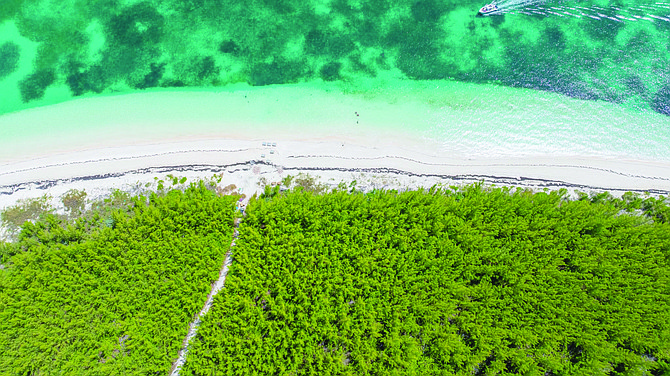
GILLAM BAY, GREEN TURTLE CAY, ABACO
By RASHAD ROLLE
Tribune News Editor
rrolle@tribunemedia.net
A SUPREME Court judge has stopped all work on a controversial villa development at Gillam Bay, Green Turtle Cay, raising serious questions about how the government approved the project without an environmental impact assessment or any public consultation.
Justice Franklyn Williams barred developer Reginald Curry, and anyone working for him, from any further clearing, excavation or construction at the bay, including digging pits and trenches, laying foundations and boring holes. The order also bans any works on the foreshore, waters and seabed within 300 feet of the high water mark, and the outdoor storage of mooring blocks there. It stays in force until a full judicial review of the project’s approval is decided.
The judge also criticised Dr Rhianna Neely-Murphy, director of the Department of Environmental Planning and Protection (DEPP), over the reason she gave for deciding the project did not need an environmental impact assessment (EIA). He called it “formulaic, circular and de minimis”. The law does not require her to give reasons, he said, but best practice in this case required fuller ones.
The government fought the injunction. Its lawyer, David Higgins, said the government had an interest in the project’s success and had determined that it would be of significant benefit to The Bahamas, and to Abaco in particular.
Mr Curry did not take part in the case at all. Justice Williams said every effort had been made to secure his participation. The court twice adjourned so that his lawyer, Geoffrey Farquharson, could make submissions. Mr Farquharson acknowledged the hearing dates by telephone, email and in person, and as recently as November 4 acknowledged in open court that the application was pending.
“Regrettably, he has failed and or declined to participate,” Justice Williams said.
The challenge was brought by the Save Gillam Bay Collective Ltd. It is a company formed by Bahamian citizens, residents, homeowners and neighbouring landowners with longstanding ties to Green Turtle Cay. Its lawyer, Ian Nicholas Mitchell, of Callenders & Co, certified the application as urgent. He said an order was needed “to avoid imminent risk of irreversible ecological harm and the continuance of what the Applicant says is a development progressing without lawful authority”.
“Once a coastal ecosystem like Gillam Bay is destroyed, it will be lost forever,” the group said in a fundraising appeal earlier this year.
A judicial review is a court challenge to the lawfulness of a government decision. The injunction freezes work until that challenge is decided. It is not a finding that the approval was unlawful.
The collective is challenging DEPP’s decision to grant the project a Certificate of Environmental Clearance (CEC) on April 22, 2026, and the director’s decision that no EIA was needed. Justice Williams granted it leave to bring the review. He found that the group had a sufficient interest in the matter, had acted promptly and had at least one arguable ground with a reasonable prospect of success.
The project, known as Seashells at Gillam Bay, is planned for about three acres of Crown Land. It includes nine villas of about 1,900 square feet each, a clubhouse with a restaurant and bar, an administrative office and a back-of-house facility. According to the ruling, available information about the project also refers to access works, moorings, a dock and “other marine or shoreline components”. The ruling does not say what the project is worth or how many jobs it would create.
According to the collective, work under way at the site has included clearing, excavation, boring holes, pouring concrete mooring blocks and pouring concrete columns ahead of wall construction, all in circumstances of “great ecological sensitivity”.
The ruling says the CEC was issued before any public consultation and was never made available to residents. At a community meeting in July, residents were told that the project needed only an environmental baseline assessment and an environmental management plan. None of those documents, nor the certificate, was given to them. The certificate has not been produced in court either. The court heard that two earlier certificates from 2023, for limited clearing ahead of a botanical survey and for an access road, have expired.
The judge said the director had failed or refused to provide a record of how she reached her decision, and gave no reasons for withholding it. The Department of Physical Planning produced no application for the development, and it does not appear that one exists.
In a September 11 letter, Dr Neely-Murphy said an EIA and public consultation are required only when a project poses a significant risk of harm to the environment. She judged Seashells to be of low or minimal impact. She said the project was low density, would be built on stilts, was entirely upland with no marine component, was set back more than 50 feet from the nearest dune and was not near any protected area. She said no protected species would be cut or uprooted.
Justice Williams said her assertion that there was no marine component was contradicted by the developer’s own environmental documents, which refer to moorings, a dock and other shoreline components.
The director also wrote that the developer plans a reverse osmosis plant and deep injection wells for effluent, including effluent from septic systems. She said these would be referred to the Department of Environmental Health Services, the Water and Sewerage Corporation and the Ministry of Works for permits. The judge said those approvals should come before the CEC is issued, or at least be considered before it.
“Effluent is raw sewerage, and its disposal, if not properly managed, has the potential to adversely and irremediably impact the environment,” Justice Williams said.
The collective told the court that a birdwatcher recorded 57 resident and migratory bird species at Gillam Bay between February 27 and March 6 this year. They included the Red Knot, Piping Plover, Wilson’s Plover and Peregrine Falcon. By contrast, the developer’s own bird survey was carried out over three hours. The collective said this called the developer’s ecological baseline into question.
The group also said the developer’s environmental plan includes Garlon 3A, a weedkiller containing triclopyr that may be toxic to fish. It said the plan sets out no site-specific rules for using it near the bay's shallow waters. The plan also contains no storm surge assessment of how a major hurricane would affect the development and the coastline, the court heard.
Justice Williams said that without an injunction, work under the certificate would likely continue unabated during the judicial review, with the potential for irremediable damage to Gillam Bay.
He accepted that the developer would suffer financial loss, but said the extent could not be determined because Mr Curry did not take part. The collective has offered an undertaking in damages, which means it may have to compensate the developer if the injunction is later found to have been wrongly granted. The judge will hear the parties on the amount of that undertaking, on security for costs and on costs.
The substantive judicial review was set to begin on November 11, the date of the ruling. Justice Williams said he did not expect it to be lengthy.
The ruling is the latest blow to a project that has drawn strong local opposition since July. All five members of the Green Turtle Cay District Council voted against it that month, and by August the collective’s online petition had more than 3,300 verified signatures. Former Prime Minister Hubert Ingraham, who represented the area for decades, said “the least that ought to happen” was a public EIA. Eric Carey, former executive director of the Bahamas National Trust, called DEPP’s decision against requiring one “kind of strange” for virgin land used by shorebirds and wildlife.
At a July meeting with residents, a DEPP official said the project’s conditions prohibited marine works, mass clearing and excavation beyond building foundations.




Comments
Use the comment form below to begin a discussion about this content.
Sign in to comment
OpenID