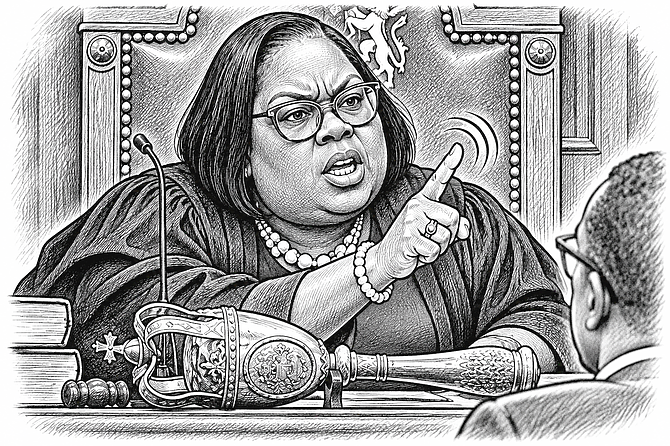
House Speaker Patricia Deveaux
IT has been a week of curious news in The Bahamas. A number of news stories have been rather strange, while others raise questions about our current reality and the people who may or may not be living in it. Let’s take a look at six of those stories.
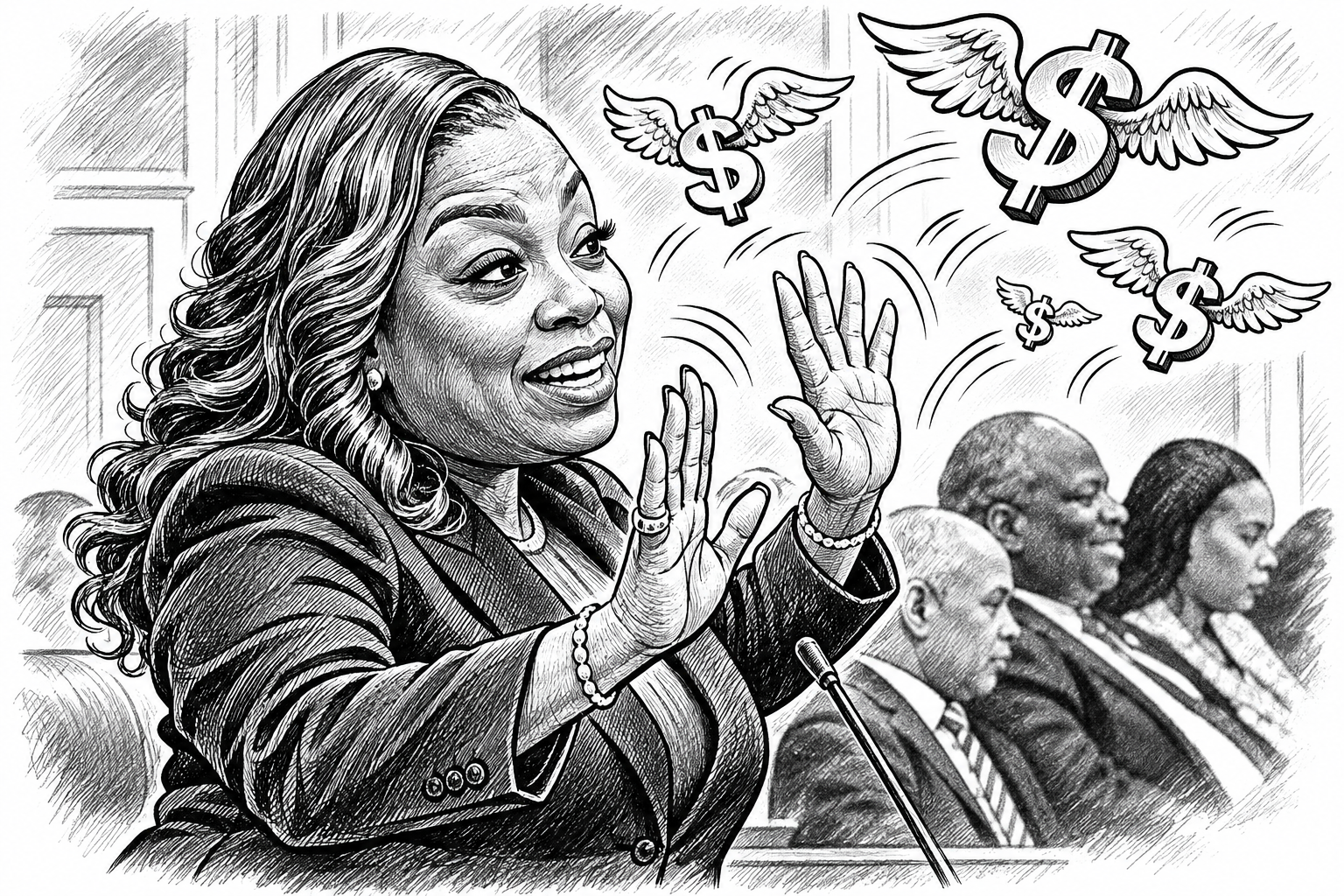 Theft of the people’s money, forgotten?
Minister of Urban Renewal and Community Development Lisa Rahming regaled Parliament with a tale of her communication with contractors engaged by the government for the Small Home Repairs Programme, on which $500,000 has been spent this fiscal year. “I wipe away all the tears. All the money that went missing, I forgot it in the sea of forgetfulness. I said today, you start on a good footing.”
As if this were not bad enough, she suggested that it was expected that not all of the work would be completed and that some contractors would abscond with the people’s money in their pockets. It seems there was an expectation on the part of the minister that a workshop would prevent fraud. She said, “Of course, we had some who took the money and we couldn’t find them. That’s why we had the contractor’s workshop.”
What would make Rahming think that she had the authority to “forget”, on our behalf, the debt still owed? Why would it be appropriate to accept the loss of the Bahamian people’s tax dollars, leaving the programme recipients with incomplete work in their homes or using more of our money to pay another potentially dishonest person to complete the work? This was said without shame or regret, in Parliament, to be reported on and shared with the public. What, might we imagine, is taking place without being shared with us? Will there ever be transparency and accountability in a Bahamian government? Will we ever get to see exactly how every dollar is spent and access the records that show whether or not the payments yielded the expected results?
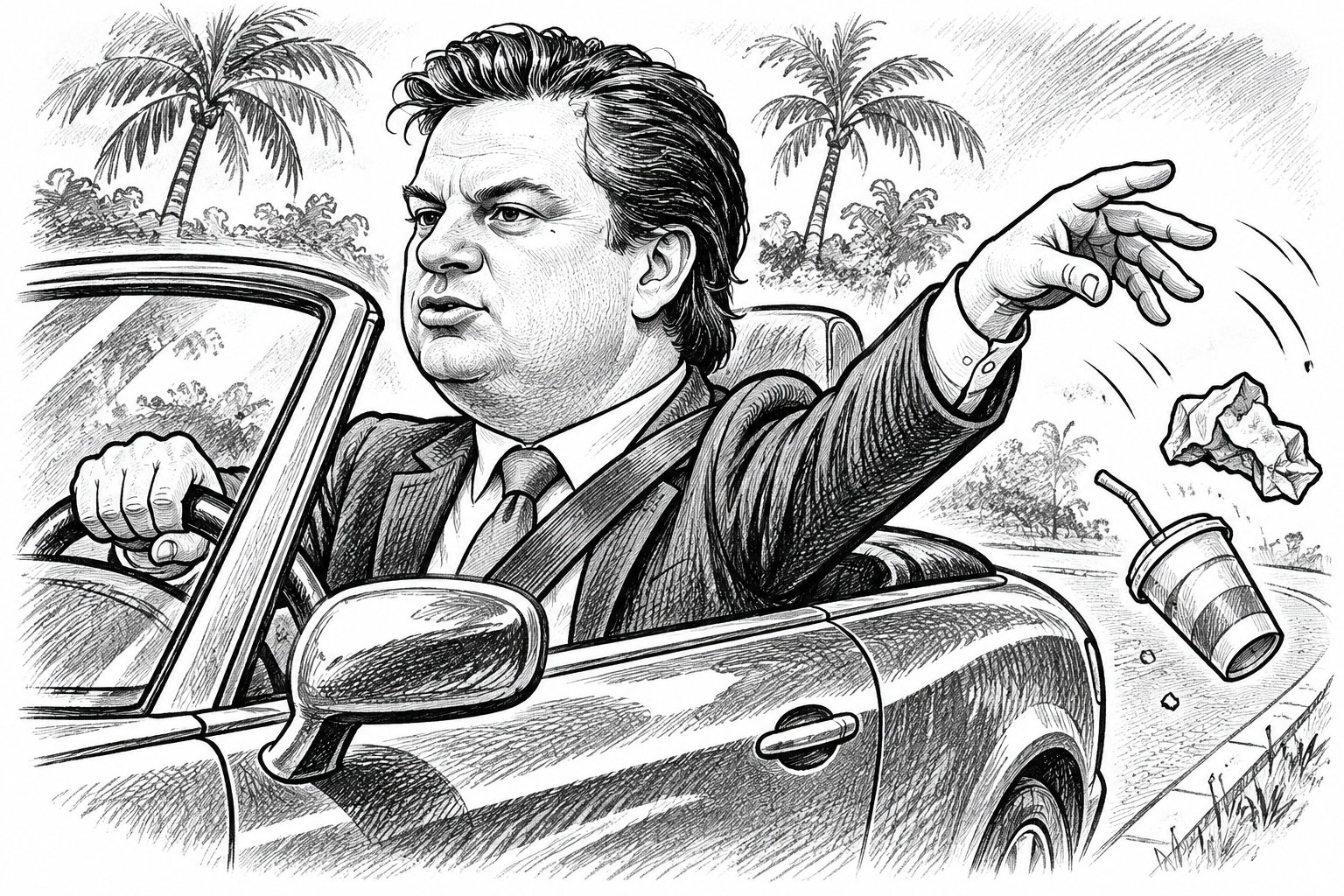
People who litter are clean?
St Anne’s MP Adrian White said, “Most people will say Bahamians are nasty people because we like to throw things out the window all the time, but I look at it from the other side of the coin. I say Bahamians are clean people.”
He continued, “They don’t want waste around them, you know. So if they’re driving in the car and there’s waste in the car, they throw it out the window. The immediate effect to them is they don’t have that trash on them no more.”
This is ludicrous. There is no rationale for people throwing garbage out of their car windows and into the street, onto pavements, into bushes or onto vacant land. There is no explanation for the idiotic decision to consume a beverage while in a car, put the window down and throw the container out of the window. There is no reason a person in a car cannot wait until they reach their destination to put their garbage into an appropriate receptacle. There is nothing clean about prioritising one’s own space by making another area dirty. White’s comments are irresponsible and could have the effect of encouraging people to continue their nasty habits.
Should there be more garbage bins? Absolutely, and they should be emptied and cleaned on a regular basis. This can begin at public parks and beaches. The nonsense White suggested, however, with a bin, backboard and target, turning the act of throwing garbage out of car windows into a game, is inexcusable and destructive.
Environmental advocate Joseph Darville correctly said, “That’s a height of nastiness. Disregard whether you’re going to call it nasty or not. It’s disregarding your environment, and it means that you put it out there because you expect some other lowly person to come and pick it up.”
Maintaining a clean environment is for the benefit of tourists?
Executive Chairman of Bahamas Public Parks and Beaches Jamahl Strachan said, “We can’t market tourism with dirty island.” He added, “Bahamians should utilise the bins because it’s not only about keeping The Bahamas clean; it’s also good for the economy and good for The Bahamas as a marketable product.”
Almost every time there is a discussion about litter and the deplorable state of this island, tourism is the first concern. Even when everyday Bahamians call in to radio shows to complain about the nastiness, they say, “This is what tourists see!” or “We can’t let this tourist see this!” It is as though we do not value our own experiences as residents of this island. It is as though the land and the people of The Bahamas exist solely to be experienced by people who do not live here.
Even if Bahamians struggle to understand our place here, Members of Parliament ought to model and encourage collective ownership of The Bahamas and its resources by the people. Our first priority is not to smile, serve and be deferential towards tourists. The economy has been built to force our reliance on tourism, but it need not be our identity. We need to respect the land and one another, beyond what one can do for the other. We live here, and we deserve to be comfortable, to have clean surroundings, to be safe and to live healthy, fulfilling lives.
Who is in charge here?
Following complaints about “rogue” DEA agents operating in The Bahamas, US Embassy Deputy Chief of Mission Kimberley Furnish said, “Why is it our business? Because our security is linked to one another, because we want The Bahamas to be safe, want the Caribbean to be safe, and we want the United States to be safe. We want our children to be safe — that’s why this matters, that’s why it’s our business. And I’m sorry, we’re not going anywhere. It’s going to stay our business.”
Bahamians certainly have a variety of views on the US, its presence in The Bahamas and what it ought to be able to do and be prevented from doing. The US has repeatedly asserted that it can and will do as it pleases, regardless of our position on it. It is rare for Bahamian officials to push back and challenge its assertions.
We can look to Trinidad and Tobago to see how far a government can go to find favour with a state pursuing a dangerous right-wing agenda. We can look to Palestine, Cuba and Venezuela to see the punishment meted out to states that do not fall in line. There is an agenda, and it is not friendship.
The victim
In his national statement to the High-Level Summit of the 31st United Nations Climate Change Conference (COP31) in Antalya, Türkiye, Prime Minister Philip Davis said that no one is coming to save us and we must save ourselves. This was followed by his plea for climate financing. How is that for an interesting combination of messages?
Davis said, “We now need international partners to fully implement the programme, who will stay the course, whose commitment is not dictated by donor cycles or ideological trends.”
It seemed as though he was echoing the cry of the Bahamian people, subject to the whims of political parties as they gain a majority in the House. “Individuals come and go. That is the flaw at the heart of everything we have done,” he said. “Implementation is frustrated because we are the inheritors of promises made by persons who no longer occupy the seats of power […] Permanence means that financing must be automatic, not merely pledged.”
As we see now, disappointment is not limited to a change of government. We can be just as stuck, and we can be left with just as many unfulfilled promises when the same people hold power and opt out of the contract they wrote themselves.
Damn disgrace
Last Wednesday, Andre Rollins called the Speaker of the House, Patricia Deveaux, “a damn disgrace”.
The Tribune reported, “Ms Deveaux insisted she was following the rules, not taking advantage of them. She told him that anyone in another person’s house had to abide by that person’s rules. She also said that if a motion were put, the government majority would defeat it.”
Rollins has certainly been encouraged by the amusement and cheering that have followed his antics in Parliament. People have made comments about him being the one to hold the government to account. He is, however, a part of the government. The FNM is a part of the government and has an important role as the opposition. It is, as we can see, a rather weak opposition, and not only because of its numbers. It is depending heavily on pageantry to get attention rather than focusing on increasing its effectiveness. This, of course, does not excuse the unsatisfactory behaviour of the Speaker, which helps to turn Parliament into a display of childish ego battles.
It ought to concern the entire country that the Speaker likened Parliament to a house of which a person or party has ownership, rather than a place for all parties to meet as equals. This, along with the taunting about any motions put forward by the FNM being defeated — with the assumption that all PLP members would vote against them without consideration — does not bode well for democracy in The Bahamas. How are the people being represented?
The Tribune reported, “Ms Deveaux later responded to the FNM’s broader complaints about her handling of the House. She acknowledged that her previous approach had been ‘toxic’ for her and for others, and said she was now determined to follow the rules and parliamentary procedure.”




Comments
Use the comment form below to begin a discussion about this content.
Sign in to comment
OpenID