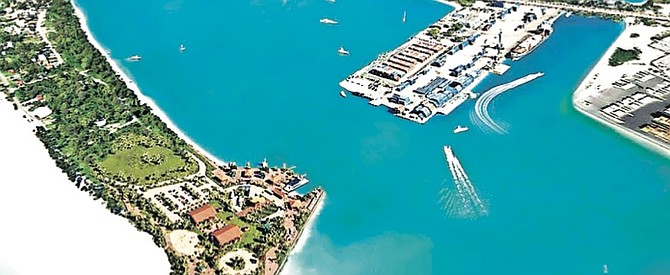
Bahama Rock Expansion
By NEIL HARTNELL
TRIBUNE Business Editor
nhartnell@tribunemedia.net
BAHAMIAN contractors were yesterday breathing “a sigh of relief” after being told Bahama Rock will re-open tomorrow to end a local supply shortage that has sent aggregate prices soaring by up to $20-$30 per ton.
Glennett Fowler, founder and group president of the Heroic Group, which includes Heroic Concrete & Concrete Products, told Tribune Business that Bahama Rock management has confirmed it will resume supplies at existing price points as the 60-day temporary shutdown, which resulted in 69 hourly-paid staff being furloughed amid the wait for regulators to approve its mining of the 515-acre Bahamas Cement Company site, comes to an end.
She voiced optimism that the move will stabilise the construction industry’s supply chain and costs after major cement providers revealed earlier this month that concrete prices would increase by 11 percent, or around $30 per cubic yard, as a result of having to replace Bahama Rock’s aggregate with more expensive imports from the Dominican Republic.
Ms Fowler told this newspaper that the loss of Bahama Rock’s supply had caused materials shortages and “delays” for multiple construction projects across The Bahamas over the past two months, with no other local source proving an adequate replacement given that Freeport Aggregates requires another year for its promised $8m investment to “ramp up” capacity.
The Heroic chief added that Bahama Rock’s re-opening came just in time for her operation as it had “run out of on-hand material” that was stockpiled in a bid to last out the latter’s two-month closure. Disclosing that consistent concrete production had been “touch and go”, she said the situation must spark a national discussions on “what this means for supply” and the need to prevent the availability of critical materials being “concentrated” with just one source
Bahama Rock and its parent, US materials giant, Martin Marietta, did not respond to e-mailed Tribune Business inquiries before press time last night, but Ms Fowler said it had confirmed the supply resumption when contacted by Heroic.
“I believe we would have phoned their office once we heard the communications being circulated,” she added. “It wasn’t anything official; it’s just we would have contacted them.
“We’re excited to hear that Bahama Rock is opening up. There’s a number of delays on projects across the country because of the lack of supply of aggregate, and material coming in was $20 a ton higher and, in some cases, almost $30 a ton higher.
“Bahama Rock is going to be supplying from their stock that they have available, and the price point is not going to increase. They are maintaining prices, and based on the schedule of delivery they have worked out with us, we will have Tuesday and Thursday for picking up.”
Ms Fowler, though, said it remains unclear whether Bahama Rock’s re-opening will be for the long haul or just a short-term event. She added that its management have provided “reassurances” that the company and its supply will remain open and available for the remainder of 2026.
“It almost puts us in a position where we have to buy more than we need,” she told Tribune Business. “We haven’t heard what the long-term position of Bahama Rock is, and definitely need to have discussions on what this means for supply in this country.
“There’s no information that we reliably have to say how long they will remain open, or if this is a long-term opening, but we have reassurances from the management team they will be open for the year; they will be open for the rest of the year. I cannot speak beyond that. It would be good to know if this is a short or long-term opening.”
Bahama Rock temporarily ceased operations in mid-September 2026 amid the wait for regulators, especially the Department of Environmental Planning and Protection (DEPP), to determine whether they will issue permits and approvals for it to quarry and mine the former 515-acre Bahamas Cement Company site on the western side of Freeport Harbour.
The company and its US parent are arguing that a go-ahead is critical for its long-term future and sustainability in Grand Bahama as the supply of aggregate at its existing location has been exhausted. However, the move is facing major opposition from residents in Eight Mile Rock and nearby communities, who fear both the environmental impacts and the effect of blasting on their homes and businesses.
Still, Ms Fowler hailed Bahama Rock’s re-opening as “a great relief” for the construction and development industries in both Grand Bahama and the wider Bahamas. “Most of us, at this point last week, we would have run out of local material or on-hand material that we tried to stockpile,” she told Tribune Business.
“This is a sigh of relief for us, and we are hopeful they can maintain supply for a scheduled period while they work through the resolution with DEPP. It was a need that needed to be filled, particularly the fact we are depending on supplies. The material we need is really critical and essential for the product of concrete, and not just concrete, but fill material and construction material that is needed across the country.
“The impact in the short-term [from Bahama Rock’s closure] has been fluctuations in cost due to higher-priced materials coming in and there were a number of people oit of work due to lulls that existed. Availability of materials creates a better investor confidence measure in the sector, but we should not have so much material concentration, that’s the thing.”
Freeport Aggregates had previously pledged to the Government that it is investing a further $9m to expand production and fill the void created by Bahama Rock’s temporary shutdown through servicing contractors and “all of the local needs in The Bahamas”. However, Ms Fowler said it will likely take time for it to increase output to the necessary level to meet national demand.
“One of the things is that Freeport Aggregates issues refunds to some of us because they were not able to fulfill the order,” she revealed. “I believe their intention is to ramp up next year and they weren’t able to get the order fulfilled.”
Still, the Bahama Rock-related relief was not just confined to Grand Bahama. Robert Myers, a former Bahamian Contractors Association (BCA) president, told Tribune Business that news of its re-opening and supply resumption was “fantastic”.
“That’s great news, that’s very good news,” he added. “That will be a welcome relief for sure. It will bring prices back down almost immediately. They’ll have to get rid of the stockpile they have now, but at least they are back into bringing the cost back down.
“It’s immediate. As soon as that rock goes down in price, the concrete prices will go back down. They were already high, but certainly it’s a relief. It will also help with the supply disruption. With the weather now, good luck getting a barge from the Dominican Republic. It helps a lot.”
Bahama Rock, in a presentation made during the July 29 town hall meeting on its project, had warned of potential construction materials shortages and spiking development/building costs as it disclosed that The Bahamas requires more than 350,000 tons of aggregate per year.
It asserted that the loss of its supply source would double the cost of such materials for the Bahamian construction industry and result in delivery costs per ton being “up to 150 percent higher” due to extra import-related expenses - a reality that started to play out almost immediately following its temporary closure.
Bahamas Redi-Mix, one of the nation’s major cement and concrete suppliers, warned that having to replace Bahama Rock with aggregate sourced from the Dominican Republic “at almost double the cost” left it with “no choice” but to raise prices for customers.
Phil Andrews, its managing director, in a message seen by this newspaper, wrote: “Unfortunately, the aggregates from the Dominican Republic are almost double the cost of those from Freeport and we have no choice but to pass the cost along.
“We are hopeful that Freeport will resume operations shortly and we can get back to current pricing. The new price for the attached mix design will be $305 per cubic yard plus VAT.”
He reiterated this in a subsequent message, adding: “As I am sure you are aware Bahama Rock is temporarily closed, and to continue operations our local rock supplier has had to source alternate materials. They have just received a shipment form the Dominican Republic at costs almost double those of the Freeport aggregate.
”We have no choice but to pass this increase on but are hopeful that Freeport will resume operations soon. As a result, our prices will be increased on November 9, 2026. We regret having to do this but have no other choice until Freeport resumes shipments. Prices will be reduced as soon as we can resolve this issue. We… will strive to do all we can to continue to provide you with quality concrete as reliably and efficiently as possible.”
Mr Myers earlier this month calculated that concrete prices were set to jump by 11 percent, or around $30 per cubic yard, due to the loss of Bahama Rock’s supply. This came after a 17 percent increase earlier this year prior to the Grand Bahama supplier’s closure.
He added that, compared to US prices, Bahamian concrete costs per cubic yard would rise to $305 - around $95-$125, or between 31 percent to 41 percent, higher than the $180-$210 per yard delivery cost typically found in the US following the latest hike.




Comments
Use the comment form below to begin a discussion about this content.
Sign in to comment
OpenID