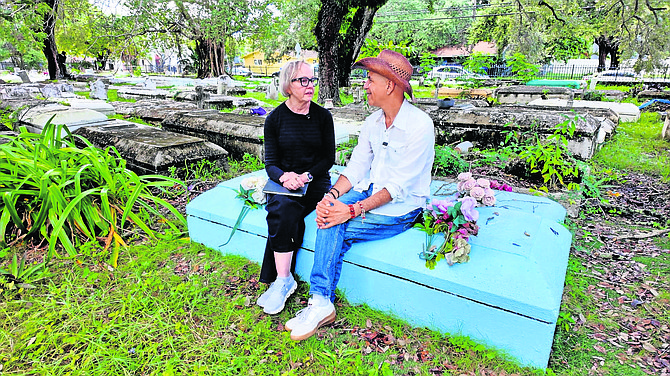
Lea Nickless and Charlie Bahama share a conversation while seated on a flower-adorned, blue-painted tomb at the historic Coconut Grove Cemetery.
By CHARLIE BAHAMA
There is a documentary film coming on this subject, one I actually started back in 1916, without even knowing it. This was when my own great-grandfather, Asa Washington Smith, made his way over to Coconut Grove from Grand Bahama.
But more on this later. I first started finding out about the importance of Bahamians in South Florida about 20 years ago, when I began producing videos for the Miami-Dade Chamber of Commerce.
The Miami Dade Chamber of Commerce was founded in 1974 to advocate for the needs of a growing small business community, especially minority-owned businesses that had historically been marginalised.
They enlisted me to create stories and highlight people in Miami-Dade who had made important contributions to our community. These people were the movers, shakers, and pioneers of South Florida, and the more videos I shot, the more I discovered that most of them had some Bahamian connection, whether they were born there themselves or had Bahamian parents or grandparents.
It was a pleasant surprise to detect that slight Bahamian accent or recognise a familiar Bahamian last name. The more and more I met these folks and heard their stories, the more I realised what a strong legacy Bahamians had in the making of South Florida. Coincidentally, the Miami-Dade Chamber of Commerce's current president, G. Eric Knowles, is Bahamian.
Like I said, I had a similar story of my own. My great-grandfather, Asa Washington Smith, brought his family over from Grand Bahama, and they became pillars of the Coconut Grove community. One of the popular landmarks was The Royal Poinciana, where Bahamians from all over Miami would congregate to fellowship, drink, dance, and get a familiar taste of the Bahamas they had just left behind.
The Royal Poinciana was at the west end of Grand Avenue, and I remember going by there when we visited from Nassau. I would eagerly look forward to getting an ice-cold orange Nehi soda from Aunt Joyce because we didn't have that in Nassau. I was just a kid, so at the time, I didn't realise the significance of those strong Bahamian roots. I just knew that everyone in the neighborhood seemed to be from The Bahamas.
Dr. Marvin Dunn, who is also featured in the documentary, interviewed my grandmother, Laurena Smith, for his book *Black Miami in the Twentieth Century*, in which she speaks about her passage over and the Coconut Grove Bahamian community. What I've learned since then is that Bahamians were present in Key West as far back as the 1700s, but they really started coming over in the early 1800s, mainly from the Out Islands, particularly the Abaco Cays and Eleuthera.
Wrecking, sponging, and turtling were the main industries back then, and Bahamians were so successful that a Bahamian named William Curry became Florida's first millionaire. Dr. Cori Convertito, Curator and Historian at the Key West Art & Historical Society, tells me, "Key West would not be what it is today if it were not for Bahamians."
When the Keys' economy slowed in the late 1800s, Bahamians slowly migrated north to the Miami area, now known as Lemon City, Overtown, and Coconut Grove. Bahamians were skilled in farming the same type of soil and land they knew back home.
Dr. Dunn writes in his book, "Bahamians played a key role in transforming South Florida from a wilderness into a rich farmland. Coral Gables founder George Merrick noted that the Bahamian blacks dispelled white settlers' notion that growing crops couldn't be possible in the rocky landscape."
He went on to say, "In the Bahamas, there is the same coral rock; and the Bahamian negroes knew how to plant on it; how to use it; and they knew too that all kinds of tropical trees would grow and thrive on this rock."
And when Henry Flagler needed skilled laborers and workers to help build his railroad, he counted on the expertise of Bahamians. They knew how to work with the coral rock, and Flagler and other prominent builders in Miami needed and respected their skills.
James Deering also employed and depended on Bahamians to build his Italian Renaissance villa on Biscayne Bay, now the iconic Vizcaya Museum. When Miami finally became a city in 1896, a significant number of Bahamians signed the city charter. There is no question that Miami wouldn't be the successful city it is today without the contributions of Bahamians.
Dr. Dunn tells us in the film, "If you look at the leaders in Miami, then and now, most are of Bahamian extraction." This story was particularly close to my heart, especially because it is also the story of my own Coconut Grove Bahamian family, with my father featured in the documentary as well. It all began back in 2019 with then-Minister of Tourism Obie Wilchcombe, but COVID hit, and the project came to a halt.
Then Minister Wilchcombe suddenly passed away, and it seemed as if this important story would never be told. It wasn't until artist and researcher Lea Nickless contacted me about her Coconut Grove Cemetery Project that the flame was reignited to finish this important piece of Bahamian history.
Nickless' project documents the graves and stories of the people buried in that cemetery, and it wasn't until she started researching that she discovered the strong connection to The Bahamas. My grandmother, great-grandparents, and other members of my family who made their way over from Grand Bahama are buried there, so she contacted me to learn more about their stories.
As respected Bahamian-American historian Dr. Enid Pinkney reflects in the documentary about what contributed to our Bahamian excellence in South Florida: "I believe it is our Bahamian heritage, and I think we need to get that back and pick up the left of what we left out, so we can become whole."
As most of the interviewees in the documentary lament, we need to tell our own story because, far too often, we expect others to tell it for us. So, on that note, rest assured that the story of how Bahamians helped make Miami a city will be finished in 2027.
Until then, do yourself a favour and do a little research of your own into just how important Bahamians were to the making of one of the most vibrant and important cities in the world. Catch the Charlie Bahama Show episode featuring my conversation with Lea Nickless about Bahamians in Miami this Saturday night at 8:00 p.m. on Cable Bahamas, Channel 212.
And be sure to follow all Charlie Bahama social channels or subscribe to the Charlie Bahama YouTube channel.




Comments
Use the comment form below to begin a discussion about this content.
Sign in to comment
OpenID