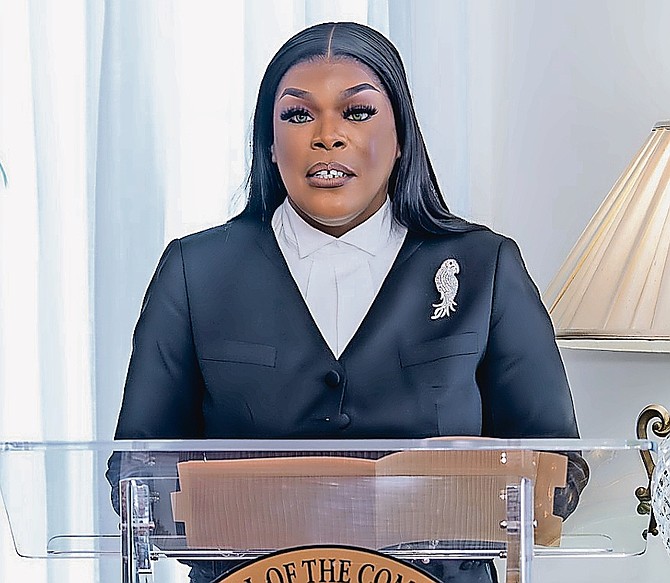
Director of Public Prosecutions Cordell Frazier
By PAVEL BAILEY
Tribune Staff Reporter
pbailey@tribunemedia.net
MORE than two years after Prime Minister Philip Davis vowed to come after anyone “associated with a gang”, the first case brought under his government’s Anti-Gang Act is headed to trial, with two men accused of gang membership and of seriously injuring a rival in 2022 due before a judge next May.
Davonne “Von” Brown Jr and Cedric “CJ” Thompson were first charged with causing dangerous harm after prosecutors alleged they seriously injured Anton Newbold, whom they describe as a member of a rival gang, on May 10, 2022.
Prosecutors have now added the gang charge, alleging the pair belong to a gang based in eastern New Providence.
“They had a preexisting charge, and there was other evidence to suggest that they were a part of a gang, so they were charged under the gang legislation,” Director of Public Prosecutions Cordell Frazier told The Tribune yesterday. “The gang charge was added to an existing matter.”
Justice Franklyn Williams told the men during case management on Tuesday that their trial would begin in May.
If convicted of gang membership, each could face up to 25 years in prison.
The trial will be the first real test of a law Mr Davis sold to the country as its answer to rising gang violence and tit-for-tat killings.
“We are going to introduce the toughest Anti-Gang Legislation ever. If you are associated with a gang, we are coming after you,” he said in a national address before the bill went to Parliament.
The Act was passed in April 2024 and came into force on August 1 that year, but the promises of prosecutions kept coming while the cases did not.
In February 2025, Commissioner of Police Shanta Knowles said police were investigating their first case under the law and hoped to put people before the courts very shortly.
Six months later, Mr Davis said charges would come “very shortly”, with authorities reviewing a couple of files.
By January this year, Commissioner Knowles said police had hit a “roadblock” with the legislation and were in talks with the Director of Public Prosecutions over amendments she did not specify.
Police wanted stronger protection for witnesses willing to testify against gangs, and in September 2025, Wayne Munroe, then National Security Minister and now Attorney General, said the government intended to amend the law to provide it.
In March, Mr Munroe said investigations had reached a “critical point” as rules allowing witnesses to remain anonymous for set periods were laid in Parliament.
“They wanted anonymity for witnesses. I laid it in Parliament two weeks ago,” he said.
The penalties go well beyond membership.
Anyone convicted of gang-related activity, which includes committing a serious offence for the benefit of a gang, taking action in retaliation on a gang’s behalf, and kidnapping or extortion for a gang, is liable to a $100,000 fine and 25 years in prison.
Where gang-related activity leads to a death, every gang leader, gang member and anyone else responsible for the act faces life imprisonment.
The law defines a gang as three or more people, formally or informally organised, who act alone or together with the aim of taking part in gang-related activity.
Prosecutors can prove membership through admissions, tattoos, clothing, symbols, codes, statements made on a gang’s behalf, and evidence of association with a gang.
Taking revenge on someone for refusing to join a gang, leaving one or giving evidence against one carries up to 20 years, as does harbouring a gang member, a provision that drew criticism from Opposition leader Michael Pintard because parents of children in gangs could be charged.
Officials have said enforcing the law requires extensive intelligence gathering so that cases can withstand scrutiny in court, and that they are targeting not only those who commit violence but also those who organise or support gangs behind the scenes.
Gang laws have stumbled in Bahamian courts before.
In 2015, the first men charged under a 2014 Penal Code amendment making gang membership an offence had their charges dropped within a month, after a Supreme Court judge noted there was nothing before the court showing when the law had come into force.
Assistant Director of Public Prosecutions Basil Cumberbatch is prosecuting the case.




Comments
Sickened 7 hours, 5 minutes ago
Well I hope something comes out of this. But I'm not holding my breath as most of our criminals get bail and the chance to murder etc. a few more time while out on bail. Our system is broken!!!
Sign in to comment
OpenID