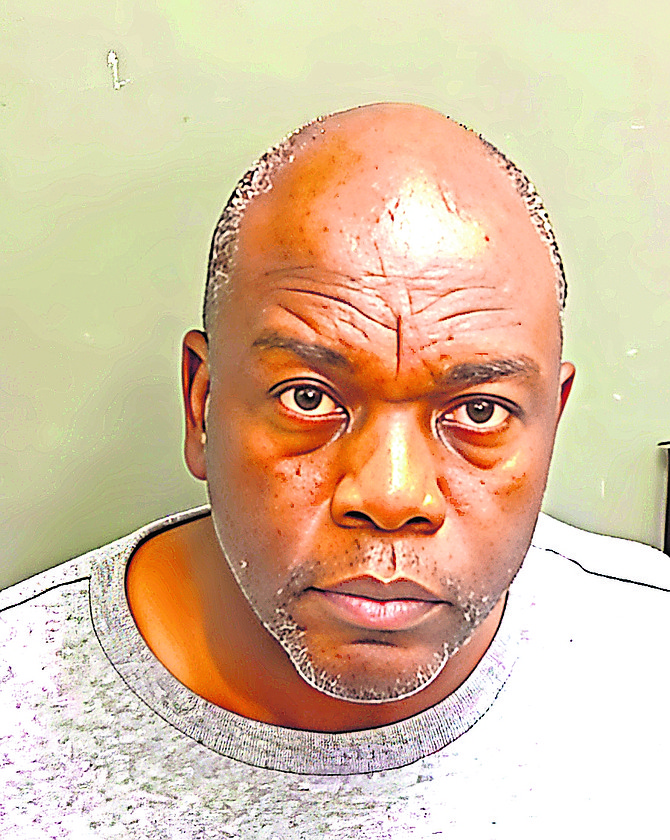
Eric Gardiner
PROSECUTORS in New York called the type of meeting with Eric ‘Player’ Gardiner which usually signals they are trying to convince him to change his plea.
But his attorney Susy Ribero-Ayala told US District Judge Lewis Liman on Friday that what’s known as a “reverse proffer,” called by the Southern District of New York (SDNY), lasted just “90 seconds,” leaving her “not sure what happened”.
“Not sure what happened,” says Gardiner lawyer, “There was no at
“There was no attempt to confer”, she told the US Federal Court in Manhattan
A “reverse proffer” is usually part of plea negotiations where prosecutors lay out their evidence to a defendant and their lawyer, often to show how strong their case is and to encourage a guilty plea as part of a plea deal.
Friday’s hearing was for US District Judge Lewis Liman to hear arguments on various motions filed by Ms Ribero-Ayala, who said she was trying to obtain more details of the case against her client, who is facing fresh cocaine smuggling charges both in New York and Georgia.
She told the court that the latest indictment only outlined in “broad brush strokes” how Gardiner was alleged to have taken part in the conspiracy in which 15 people have been indicted.
The other defendants had more detailed explanations of what their role was, but Gardiner did not, she said.
Among developments in Friday’s hearing, the court heard allegations that:
• it was a US “special ops team” that rescued Gardiner in May this year, not the US Coast Guard. She did not elaborate.
• the person known as ‘Politician-1’ was “taking cash in order to provide protection.”
• officers from the Royal Bahamas Police Force (RBPF) provided “protection” for drug traffickers using their guns.
• there was evidence that co-conspirators bragged Gardiner was a “big drug dealer” and “one of our guys.”
Ms Ribero-Ayala also referred to “multiple pen registers” – a call logging device used in surveillance by law enforcement agencies - including some with “officials” that is part of the prosecution’s sprawling, high-profile case.
She claimed that a phone call to “the Prime Minister of The Bahamas” was one such “pen register” among the evidence.
She did not name Philip ‘Brave’ Davis in court, but later confirmed to reporters that she was referring to the incumbent prime minister. There is no suggestion Mr Davis has done anything wrong or is in any way connected to the case. There was no detail given about where the surveillance device was deployed or which country’s network was being used.
The wide-ranging case involves alleged drug trafficking from Colombia through the Bahamas and on to the US, with links to a drug trafficking gang in Georgia.
It stems from a November 2024 indictment of 15 people including 11 Bahamians who are accused by prosecutors in the Southern District of New York (SDNY) of cocaine trafficking and firearms offences.
Among the defendants is Gardiner, 58, aka ‘Player,’ who was arrested on May 12 this year after the plane in which he and ten others were flying crash landed in the sea off the coast of Florida.
Gardiner, whose address has been given as ‘Long Island, The Bahamas,’ is accused of conspiring to import cocaine into the US, firearms possession in furtherance of a drug trafficking crime, and conspiring to possess firearms in connection with the alleged drug scheme.
The first matter to be dealt with on Friday was the defence’s request for a “bill of particulars” about the alleged offences, in particular the gun allegations, which dated from between 2016 to 2021.
Ms Ribero-Ayala said she had reviewed audio and video recordings handed over by the prosecution and that there was none of Gardiner speaking.
There were, however, some of the other defendants mentioning him saying things like: “Oh yea, he’s a big drug dealer” and “OK, I will set up a meeting” with him.
Ms Ribero-Ayala said she needed a clearer understanding of what Gardiner was accused of, and how it related to separate, similar charges he is facing in a Georgia court.
She also said she wanted more information about where exactly Gardiner was arrested, telling the court he was rescued on Election Day in the Bahamas on a plane with poll workers and people being taken to vote.
She told the court that she had “information they were rescued by a Special Ops team” and not the US Coast Guard as the prosecution had claimed.
“I would like to know….if they were rescued in Bahamian waters or international waters or Florida waters,” she said.
Judge Liman appeared skeptical and said MsRibero-Ayala was “free associating” but asked Assistant US Attorney Jonathan Bodansky to explain.
Mr Bodansky said that the firearms were part of a “lengthy conspiracy” and that they in part related to the guns used by law enforcement officers who were allegedly involved.
According to Mr Bodansky, these firearms were used for “providing protection” for drug traffickers.
Judge Liman asked: “Is there evidence with respect to the Bahamian police forces possessing firearms and offering to use them in connection with drug trafficking?”
Mr Bodansky said: “Yes, Your Honour”.
Judge Liman then turned to Ms Ribero-Ayala’s request to suppress the $30,000 that was found on Gardiner in a cross-shoulder body bag at the time of his arrest.
Initially, it was claimed that $30,000 in Bahamian currency was found on Gardiner that, according to prosecutors, was in an envelope marked with the name of a Bahamanian political figure identified only as “Politician-1”.
According to Ms Ribero-Ayala, the prosecution’s story about the cash was a “misrepresentation”.
In fact, $5,000 was in a white envelope with the name of “Politician-1” on it and there was an “innocent explanation” for the other $30,000 in a brown envelope, making the total amount $35,000. The total amount has previously always been stated by prosecutors as $30,000.
The $30,000 had been withdrawn from a bank, Ms Ribero-Ayala said, noting that there are no campaign contribution rules in the Bahamas.
She also demanded an explanation as to why the US government had tried to exchange the money into US currency three times.
She did, however, drop her request to have the money returned to Gardiner on the basis that the prosecution was now going to use the cash as evidence.
According to Ms Ribero-Ayala, Gardiner was not a “target” for US prosecutors but once he was rescued, they were “seeking for something to charge him with”, hence why prosecutors characterised the money the way they did.
Mr Bodansky said that the reason the money was attempted to be exchanged was due to “competing interests” in the US government.
The DEA’s “default” move in cases where money is seized is to try and convert the money so that it can be handed over as forfeiture later in the case if a defendant is found guilty.
However, in this case the money could not be converted because it was “wet and mouldy”, the court heard.
Judge Liman asked if there was a “reckless misrepresentation” regarding the money, but Mr Bodansky said no.
While he admitted there could be a “potential correction” with regards to the specifics of the money, he maintained that it did not “impact the probable cause analysis” given the other available evidence.
Judge Liman did not appear convinced that, even if the money were not part of the case, it would change much for Gardiner.
He pointed out there was another indicted co-conspirator saying that “Mr Gardiner is one of our guys”, how the person known as “Politician-1” was “taking cash in order to provide protection” and the connections to the drug gang in Georgia.
Ms Ribero-Ayala maintained none of the recordings or video she had seen included statements from her client.
Judge Liman reserved his decision on all the motions and did not set a next date for the case to return to court.
Also accused is Elvis Nathaniel Curtis, 51, a former chief superintendent with the RBPF, who allegedly facilitated cocaine trafficking through Lynden Pindling International Airport in Nassau.
Prince Albert Symonette, 52, a former RBPF sergeant, is also accused but is not in custody.
The trial for all defendants is set for March 1 next year.




Comments
Use the comment form below to begin a discussion about this content.
Sign in to comment
OpenID