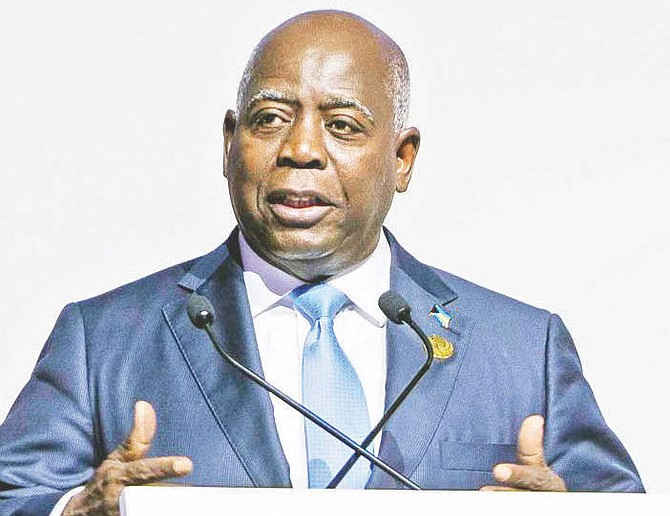
PRIME Minister Philip ‘Brave’ Davis speaks at COP31 in An- talya, Türkiye yesterday. Photo: Marvin Thompson/OPM
By FAY SIMMONS
TRIBUNE Business Reporter
jsimmons@tribunemedia.net
THE PRIME Minister last night accused oil and gas-producing nations of putting their financial interests ahead of the safety of billions of people following the collapse of climate change negotiations over disagreements on fossil fuels and financing.
In a strongly-worded statement following the conclusion of the United Nations (UN) COP31 climate conference in Antalya, Turkey, Philip Davis KC said a small number of countries had used the consensus-based negotiating process to prevent agreement on language identifying fossil fuels as a driver of climate change.
"Narrow self-interest caused this failure. A small number of oil and gas producers put their revenues ahead of the safety of billions of people," he said. "They used the rule of consensus, a rule meant to give every nation an equal voice, as a weapon to strip the cause of the crisis from the text."
The conference ended on Sunday after almost two days of overtime negotiations, with nearly 200 countries unable to agree on an overarching political outcome. It was the first time since the 2009 Copenhagen climate conference that countries had failed to reach consensus on a final outcome.
The central dispute involved whether countries should reaffirm commitments to transition away from fossil fuels, which include oil, natural gas and coal, as well as how much financial support wealthier nations should provide developing countries to adapt to climate change.
At COP28 in Dubai in 2023, countries agreed to transition away from fossil fuels in their energy systems. However, the latest proposed COP31 text made no reference to fossil fuels, prompting objections from the European Union (EU) and other countries.
Mr Davis said the omission represented a retreat from what countries had previously agreed.
"Three years ago in Dubai, the nations of the world agreed by consensus to transition away from fossil fuels in their energy systems. In Antalya, they could not bring themselves to write those words again," he said. "The final text did not mention fossil fuels at all."
The proposed agreement also dropped a $120bn annual climate change adaptation financing target that had been included in an earlier draft, another major point of contention for developing countries seeking greater support to address climate-related damage and prepare for worsening impacts.
Mr Davis said the removal of the proposed target demonstrated the extent to which the interests of vulnerable nations had been sidelined during the negotiations. "It dropped the proposed target of $120bn a year to help vulnerable nations adapt. That is the text small states were asked to sign," he said.
Mr Davis said The Bahamas refused to accept the proposed outcome alongside the Caribbean Community (CARICOM) and the Alliance of Small Island States, arguing that vulnerable countries should not be expected to endorse an agreement that failed to address the causes and consequences of climate change.
He highlighted CARICOM's decision to negotiate as its own bloc at a COP conference for the first time, stressing the regional grouping and the Alliance of Small Island States were right to reject the proposed text. "The Bahamas, a member of both, stood with them," he said.
Mr Davis argued that small island nations are being disproportionately affected by a crisis to which they have contributed relatively little. "Small island states produce less than 1 per cent of global emissions, yet we carry the weight of a crisis we did not cause," he said.
Mr Davis also pointed to the International Court of Justice's unanimous opinion last year confirming that states have binding obligations under international law to protect the climate system.
He warned that the consequences of delayed climate action will extend well beyond the countries involved in the negotiations, particularly for younger generations who would inherit rising sea levels and increasingly severe climate impacts. "In Antalya, those obligations were traded for the profits of the present," Mr Davis said.
“This failure will outlive everyone in this room. It will outlive our generation. The sea will go on rising for centuries, even after emissions stop, because the deep ocean and the great ice sheets respond slowly to the heat we add today. Every year of delay fixes a burden on people who will live centuries from now, and they will have no way to send it back. Those who blocked progress have misjudged even their own interest.”
Mr Davis said The Bahamas will continue working with CARICOM and the Alliance of Small Island States to press for stronger commitments and meaningful progress ahead of COP32, scheduled to take place in Addis Ababa, Ethiopia, in 2027.
"We will return to the table, because it remains the one place where a small nation can stand as an equal," said Mr Davis. "Antalya gave them a shameful answer. Addis Ababa must give a better one."




Comments
Use the comment form below to begin a discussion about this content.
Sign in to comment
OpenID