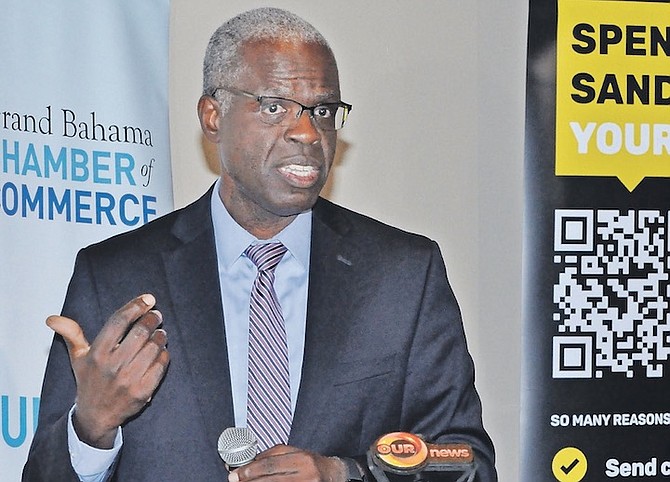
During a meeting of the Grand Bahama Chamber of Commerce Central Bank governor John Rolle spoke to members about the Bahamas’ digital currency, the Sand Dollar. Photo: Vandyke Hepburn
BY NEIL HARTNELL
TRIBUNE Business Editor
nhartnell@tribunemedia.net
THE CENTRAL Bank’s governor yesterday conceded that “service quality standards” have slipped over the speed at which it processes exchange control approvals - a permission vital to the smooth functioning of The Bahamas’ foreign direct investment (FDI) economy.
John Rolle, in a statement responding to Tribune Business inquiries, acknowledged that the time taken to process investment-related applications “has recently become more protracted” after multiple commercial attorneys and realtors voiced “exasperation” that the wait for exchange control approvals now extends to months rather than taking between two to four weeks.
Pledging that the banking regulator has already moved “to look at concrete ways to improve service”, he added that it is also exploring “additional categories of transactions” that could be exempted from having to go through the exchange control approvals process and aiming to release these proposals for public feedback early in 2027.
“The Central Bank acknowledges that the processing time for investment-related applications our through Exchange Control Department has recently become more protracted. This is not the standard of service quality for which we strive. We understand and appreciate the importance of all commercial applications,” Mr Rolle told this newspaper.
“The Central Bank has already started to look at concrete ways to improve service through both more administratively efficient processes and streamlining of exchange control policies that govern certain investment transactions.
“We are exploring what additional categories of transactions could be exempted from Central Bank approval once the Bahamas Investment Authority (BIA) oversight is maintained. We expect to share these proposed reforms with the public early in the New Year after we have consulted on them with the Government,” he added.
“Our administrative processes however, rely on the efficiency of centralised e-mail addresses and portals because they ensure that there is enterprise-level visibility and knowledge of the applications being submitted. We are leveraging these systems to target and track our improvements. We will use them to strengthen the upfront responsiveness to the public.”
Mr Rolle spoke out after all attorneys and realtors spoken to by Tribune Business confirmed there had been a noticeable slowdown this year over the time the Central Bank is taking to process exchange control approval applications. Several asserted that used to take between two to four weeks is now taking up to two to three months, making it difficult for them to advise international clients on when key commercial transactions can get the go-ahead and complete.
They added that smooth, predictable exchange control approvals are vital to the Bahamian economy’s performance and job creation because they facilitate the very foreign direct investment (FDI) projects and real estate purchases for which it leans on heavily to drive gross domestic product (GDP) growth.
One realtor, speaking on condition of anonymity, said a foreign client selling a property to a Bahamian buyer had waited three months for the necessary exchange control approvals so that he could convert the purchase proceeds and repatriate them out of the country.
“We have a deal that closed three months ago, and I’ve been reaching out to my contacts, dealing with the lawyers. It’s a mess,” the realtor said. “All the lawyers are saying it’s terrible. It’s slowing down the ability to do business, the ease of doing business. It never ends. A foreigner selling to a Bahamian buyer cannot have access to their money.”
Another realtor added: “For some reason the approval process is drawn out. I don’t know the reason why at all. From a real estate perspective, when we are looking for foreign investment, it’s not an easy and comfortable position to be in. The whole purpose of getting that permit for the purchase is that, when you sell it, you have the authorisation to repatriate your funds. You can repatriate your funds back home, but how long is it going to take you now?”
David Morley, the Bahamas Real Estate Association’s (BREA) president, signalled to Tribune Business he was aware of the concerns and said this nation must demonstrate through actions that it is “open for business” and not merely talk it.
“From a BREA perspective, if there is a delay going on it would be nice for the Central Bank and the Government to advise what their plan is and when it will be fixed,” he added. “Anything of that sort leaking out to potential investors is possibly going to trouble investment coming into the country. If we are open for international investment business, let’s be open.”
Attorneys, meanwhile, are voicing “frustration” and “exasperation” over the increased waiting time for exchange control approvals. They said the delays and hold-ups have become especially noticeable during the 2026 second half, with some attributing it to the fact that applications now have to be submitted and funnelled through an online portal rather than sent to managers and officials in the Central Bank’s Exchange Control unit directly.
“It’s exasperating. I just share the frustration, and I am not sure why it is,” one attorney said on condition of anonymity. “With some diligence you can get through on the phone and talk to someone but it seems they’ve got a bureaucracy over there. It’s taking a long time to get a letter published.”
The attorney said exchange control approvals are required for companies deemed resident for exchange control purposes, and if there is any change in the beneficial ownership of such firms if they are owned by non-Bahamians. Commercial real estate purchases and major development/corporate projects by foreign investors and firms also require this approval from the Central Bank.
“Something needs to be streamlined,” the attorney added. “I was trying to get through to the Central Bank before you called because I have been waiting for something. There’s definitely troubles over there. We do get some indication it’s moving but it always seems to be on someone else’s desk awaiting signature.”
Another attorney added: “I can tell you that, for commercial transactions I am aware of awaiting exchange control approval, there has been a delay that is not normal for the Central Bank. It used to be that you would probably hear from them in two weeks and, if it was something particularly challenging, four weeks.
“It’s proving longer than that… The Central Bank really was, I would say, the most efficient out of any of the regulators in terms of timelines. Unfortunately, it’s now north of four weeks; two months and so forth is definitely what we appear to be getting in certain instances. I’ve noticed it within the past four months, certainly this year. I would say in the second half of this year.”
One of their colleagues, also speaking on condition of anonymity, described the time that the Central Bank is taking to process exchange control approval applications as “a huge problem”. They added: “We have issues with regard to how they are processing things, and fast requests are going unaddressed and unanswered.
“Where you used to be able to write to the exchange control manager, they are using a portal. Some of these applications can be so subjective that you cannot use a portal properly. Who’s responsible for responding to it in any definitive fashion? That’s the real problem. It’s a vexing problem. It impacts everything.
“I used to use three weeks for an approval, 21 days rule of thumb. Now, I can tell you that is not the case. I can tell you that, if you get anything back within six weeks, that’s the standard. You used to be able to write to the manager of the exchange control department, they’d reply to say they had received it, and the official handling it would have direct contact with you. That’s not the case today,” they continued.
“In small economies you need to be dealing with the regulators directly. If you don’t have someone to speak to, it’s not going to work. They are the gate keepers.” The attorney then warned that The Bahamas “will not have investment unless there’s exchange control approval.
“Investors and financiers depend on its ability to extract capital and gain a return on their investment,” they said. “To get that, they need exchange control approval to be able to repatriate profits and dividends. They need ‘approved investor’ status from the Government.”




Comments
Use the comment form below to begin a discussion about this content.
Sign in to comment
OpenID