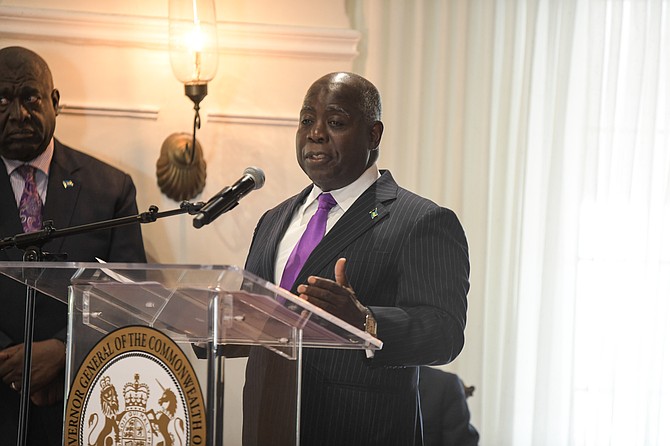
Prime Minister Philip "Brave" Davis
By LEANDRA ROLLE
Tribune Chief Reporter
lrolle@tribunemedia.net
JUDGES would receive between $30,851 and $34,317 more a year in salary and housing allowance, and stand to collect between $86,000 and $96,000 each in back pay, under recommendations tabled in the House of Assembly yesterday.
The Judges Remuneration and Pensions Commission 2024 recommended salary increases that would compound to nearly 22 percent over six years, backdated to July 2021. They would lift the Chief Justice's salary from $135,231 to $164,548.
Prime Minister Philip Davis tabled the commission's report. The law requires a commission to be appointed every three years to review judges' salaries, allowances, pensions and other benefits. Mr Davis said none was appointed in 2021, so the report covers two periods: 2021 to 2024 and 2024 to 2027.
The commission recommended a six percent rise from July 2021, followed by three percent in July 2022 and July 2023. A four percent rise would follow in July 2024, with two percent in July 2025 and July 2026.
Under the commission's figures, the Court of Appeal president's salary would rise from $130,338 to $158,593. Senior Justices of the Supreme Court would go from $127,321 to $154,923, and puisne judges from $119,248 to $145,099.
Justices of Appeal would rise from $127,321 to $155,687. The commission found their pay had wrongly fallen level with that of Senior Justices because earlier recommended increases were not applied properly. It recommended restoring the gap between the two posts.
The commission also recommended a $5,000 rise in the annual housing allowance for all Supreme Court and Court of Appeal judges, backdated to July 2024. The allowance currently stands at $63,000 for the Chief Justice, $61,000 for the Court of Appeal president and $50,000 for other judges.
Together, the salary and housing increases would lift the Chief Justice's yearly salary and allowances from $229,231 to $263,548. That counts his responsibility, housing and official entertainment allowances and his $6,000 honorarium. Separately, he receives $46,900 a year to pay domestic staff, which would not change.
The back pay figures are The Tribune's calculations from the commission's salary table, for the five years from July 2021 to June 2026. They would grow with every month the increases go unpaid.
The commission considered inflation, the rising cost of living, changes to VAT, pay in comparable Caribbean jurisdictions and the need to attract and keep talent on the bench.
The judges had asked for more. They sought 15 percent for 2021 to 2024 and 22 percent for 2024 to 2027. They also wanted housing allowances raised to $84,000 a year for the Chief Justice and the Court of Appeal president, $72,000 for Justices of Appeal and $66,000 for other judges. And they wanted the allowance folded into their base salaries so it would count towards their pensions.
The commission rejected that. It said adding housing allowances to base pay would raise the cost of the non-contributory pension fund and widen the gap with pensions paid to other public officials.
The commission made no change to responsibility allowances. These stand at $15,000 for the Chief Justice, $12,500 for the Court of Appeal president and $10,000 for other judges. The Chief Justice also receives $10,000 a year for official entertainment and a $6,000 honorarium as chairman of the Judicial and Legal Service Commission.
For retired judges, the commission recommended that the government pay the full premium for those who stay on the government's medical insurance plan, instead of reimbursing 25 percent as it does now. The commission said premiums for a retired judge alone rose from about $1,200 to more than $1,900 a month in July 2024, and to $3,726 where a spouse is covered. Spousal coverage would remain the judge's responsibility.
It said there was a strong case for adjusting retired judges' pensions so they keep pace with the cost of living. It suggested linking pensions to the salaries of serving judges, so pensions would rise whenever serving judges' pay does.
The commission also supported retired judges' requests to be recommended for national honours, invited to national events, given protocol help at airports and allowed to keep their official passports. It said these were matters for the government.
The commission turned down two of the judges' requests. Judges wanted the education allowance, now $5,000 a year per child for up to two children, extended to judges without children. The commission said the allowance was meant to meet real costs, not serve as an extra perk. It said two judges currently receive it.
Judges also asked to keep their official vehicles on retirement instead of using part of their gratuity to buy them. The commission said the vehicles are leased by the government, which would first have to buy them.
"In the circumstances, the commission is not minded to recommend that judges be allowed to retain possession of their official vehicle upon retirement," the report said. It recommended instead that retiring judges be allowed, if possible, to buy a government-owned vehicle at or below market value.
It left the question of how long judges must serve to qualify for a full pension to the government, saying it fell outside its remit. The Chief Justice qualifies after five years. The judges say all other judges must serve 13 years and two months.
The commission comprised retired Justice Estelle Gray-Evans, attorney Raynard Rigby, retired Permanent Secretary Leila Greene and accountant Peter Cartwright, who replaced the late Philip Galanis.
Mr Davis said the decision now rests with his government.
"The financial implications of recommendations, particularly those related to retroactive salary adjustments, medical insurance, and pension indexation must therefore be properly assessed," he said.
"Ultimately, the strength of our democracy, Madam Speaker, depends in large part upon public confidence in the institutions that uphold the rule of law," Mr Davis said. He said supporting the judiciary was an investment in the administration of justice and the protection of citizens' rights.




Comments
Use the comment form below to begin a discussion about this content.
Sign in to comment
OpenID