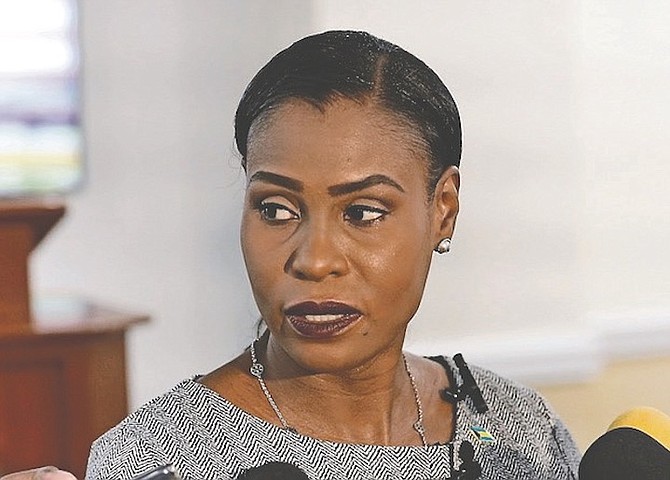
LABOUR, NATIONAL INSURANCE, AND PUBLIC SERVICE MINISTER PIA GLOVER-ROLLE.
BY NEIL HARTNELL
TRIBUNE Business Editor
nhartnell@tribunemedia.net
A CABINET minister yesterday revealed the ages of 62 and 67 are “sticking” in early debate on raising the retirement age, with “another increase” in the minimum wage also likely “in the near future”.
Pia Glover-Rolle, minister of labour, the public service and National Insurance, told the Exuma Business Outlook that consultation will occur with all stakeholders before any final decision is made on reforms set to impact every Bahamian as she voiced hope that retirement age changes can be implemented “sooner rather than later”.
Raising the retirement age has been suggested as part of a reform package to rescue the National Insurance Board (NIB), and ensure its long-term sustainability, by easing benefit payout pressure, and the minister conceded that elderly persons drawing both a pension and salary has contributed to the social security system’s stress.
Mrs Glover-Rolle signalled that raising the minimum retirement age from 60 to 62 years-old, and increasing that for the private sector from 65 to 67, is the preferred option at present. And she revealed that the National Tripartite Council, the body featuring employer, trade union and government representatives, which was formed to deal with labour-related issues, is again eyeing the minimum wage.
She disclosed that it is exploring the creation of a new body, described as “a wage-setting Council”, specifically to deal with and recommend minimum wage increases in the future. Its establishment, Mrs Glover-Rolle, argued will help move The Bahamas away from “random and ad-hoc” minimum wage rises that take employers by surprise and leave them struggling to adjust.
The minister, asserting that the Government wants decisions on labour-related issues to be “data driven” and based on empirical evidence, said a further increase in the existing $260 weekly minimum wage is likely to happen “before we get to the place of a livable wage”.
She added that worker productivity will be one factor the proposed “wage-setting council” will assess in reaching its decisions, and said the newly-formed Productivity Council is presently in talks with the National Development Plan’s (NDP) steering committee in a bid to “marry” the two initiatives and their work.
“Another important item on the National Tripartite Council’s agenda is also the extension of the national retirement age,” Mrs Glover-Rolle said yesterday. “That speaks to the sustainability of our National Insurance Fund. I want to assure you the necessary consultation and two-way communication that needs to take place along the way will happen.
“Our aim is to make a decision that strikes a balance between the interests of the employer and the employee, as well as our desire to maintain high employment numbers while ensuring employees receive suitable compensation.”
Rupert Pinder, associate professor of economics at the University of The Bahamas (UoB), another Outlook presenter, asked how raising the retirement age threshold will impact NIB claims and benefits, plus eligibility, and also questioned the status of the Productivity Council in light of the Government’s plans to increase the minimum wage.
Mrs Glover-Rolle, in reply, said the retirement age debate is not unique to The Bahamas and is an issue being discussed globally at every labour conference and International Labour Organisation (ILO) forum due to changing population demographics that have resulted in elderly persons continuing to work.
“We are looking at raising both the minimum, which is at 60, and the regular retirement age,” the minister confirmed. “That is going to be for public consultation through the National Tripartite Council, which represents all our stakeholders - the Government, employers and employees.
“They will have that dialogue to see what is the most feasible. Many numbers have been thrown out. One that is sticking is 62 and 67. Sixty-two years old was the minimum, 67 is the higher, but we also understand our state-owned enterprises, the SOEs, have a retirement age of 60 which is also affecting the Fund in terms of National Insurance.
“We look at older workers who want to return to work, who have retired and asked to come back to work. They are collecting their pensions along with a salary and that’s what’s also affecting the sustainability of the Fund,” Mrs Glover-Rolle added.
“It will be for public discussion. I hope that we can swiftly get to a place where we can make a decision as a country. I will be driving that, but it’s something that has to happen sooner rather than later if we are going to circumvent the issue of having to raise ceilings.” Mrs Glover-Rolle did not identify what ceiling she was referring to, but it could be the insurable wage ceiling.
As for the minimum wage, which was last increased by $50 or 23.8 percent, rising from $210 per week to $260 on January 1, 2023, Mrs Glover-Rolle told the Exuma Business Outlook: “In fact, as we speak, the National Tripartite Council has begun a review of the national minimum wage with views towards a wage-setting Council to be established.. to recommend increases in the future.”
Obie Ferguson, the Trades Union Congress (TUC) president, has repeatedly called for the minimum wage to be raised further to $350 per week, which would represent a $90 or 34.6 percent jump on the present figure, on the basis that $260 is simply not enough for a typical Bahamian family to exist on given the ever-increasing cost of living.
However, any increase will increase hiring and the marginal costs of employing a worker on the minimum wage, thus raising business costs at a time when employers, too, are struggling with growing expenses, especially electricity and taxes, plus the related paperwork.
Employers in industries such as hotels, gas stations and food stores that typically hire a large number of minimum wage staff will likely vehemently oppose any further rise.
In response to Mr Pinder, Mrs Glover-Rolle said “the parameters” setting out the framework under which the Productivity Council will operate were completed by its predecessor Task Force in February 2026. “The Council is now in meetings with the National Development Plan to see how we are going to marry the two,” she added.
“We are, through the National Tripartite Council, looking at the wage-setting Council as opposed to just randomly and ad-hocly raising the minimum wage… but looking at a wage-setting council that will take into consideration productivity, that will take into consideration skills” and assess “where we need to go in terms of a livable wage as opposed to a minimum wage”.
Mrs Glover-Rolle continued: “We want to use empirical information, we want to ensure it’s data driven, and we want to ensure all the stakeholders are a part of it. We want to encourage employees to understand that productivity is directly tied to compensation.”
Acknowledging that some Bahamian workers feel they are “under-compensated for the work they do”, Mrs Glover-Rolle said the Productivity Council will soon lay-out how it plans to measure productivity in “strategic, innovative ways”.
She added: “In terms of the minimum wage being raised, that is something where the conversation is already being had, and we do anticipate another increase in the minimum wage in the near future even before we get to the place of a livable wage.”
These proposed changes are taking place alongside what Mrs Glover-Rolle described as “a slate of labour reforms” that she hailed as “leading the way globally”. These include paternity, maternity and adoption-related upgrades, plus the introduction of workplace mental health standards and mental health leave and protections against workplace bullying, violence, harassment and abuse.
Mrs Glover-Rolle said the changes will cover the Employment and Industrial Relations Acts, plus the Public Service Act and General Orders, to impact all private and public sector workplaces in The Bahamas. “We are now in the final stages of undertaking the most comprehensive labour reform process in our nation’s history,” she said.
“Many of the laws that govern work in this country were written at a different time for what was a different country. The labour force has evolved and our policies and legislation must evolve with it.”




Comments
Sickened 29 minutes ago
How about this... give those close to reaching retirement age some forewarning? In other words if you're going to increase the retirement age give the people/employers 2 years notice so that both sides can plan for this change? Don't just do now starting January 1.
Also, why not put in another tier of contribution amounts with additional contributions for those people making over $100k or $150k? This minor change will help to extend the life of NIB.
Sign in to comment
OpenID