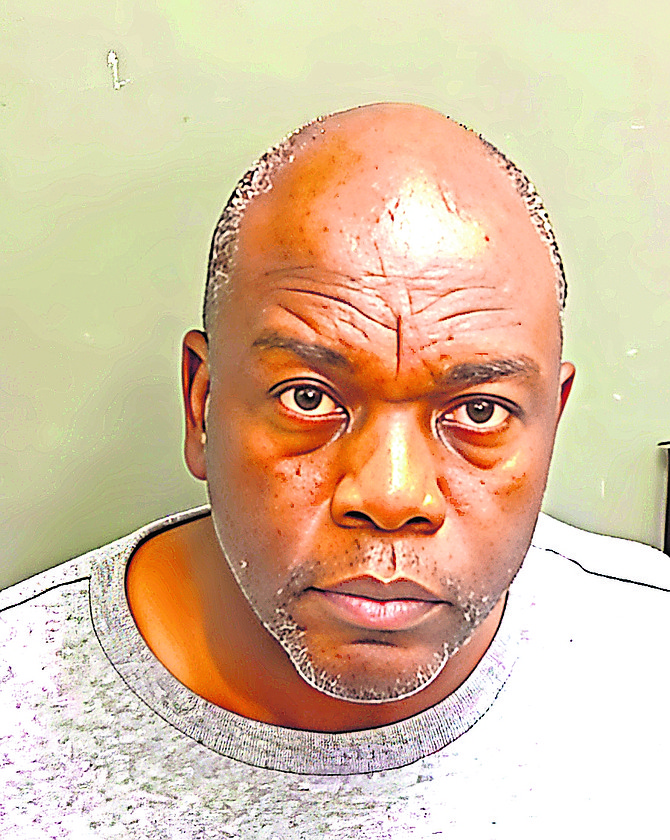
Eric Gardiner
Jonathan Eric Gardiner has asked a US federal court to order the return of $30,000 seized during his arrest, including cash in an envelope marked with the name of a high-ranking Bahamian politician.
The convicted drug trafficker, in jail awaiting trial on cocaine importation conspiracy charges, is challenging the legality of the seizure and the US Government’s continued retention of the cash, found in a cross-body bag he was wearing on the day of the election day plane crash off the Florida coast.
A flurry of filings on Friday by his lawyer, Susy Ribero-Ayala, represents the first major push back from any of the defendants in the sprawling, five-year, investigation.
Ribero-Ayala is asking for key evidence to be thrown out, suggesting correct procedures were not followed by US authorities.
One filing even asks if the US Government was aware Gardiner was aboard the downed plane before the passengers aboard were rescued.
Ribero-Ayala alleges prosecutors paint a ‘misleading’ portrait of where the $30,000 in Bahamian currency found on her client came from – wrongly inferring it as a politician-directed narcotics payment.
She states that $20,000 of it was withdrawn from an accountant at his contracting business, Top Notch Builders, at the Bank of The Bahamas, the day before the crash, and only $5,000 was in an envelope with the politician’s name on it. The Tribune has previously revealed Top Notch secured major Bahamian government contracts, including a $34 million public-private partnership (PPP) deal for the Eight Mile Rock administrative complex in May 2017.
There is no explanation as to the unaccounted $5,000.
Ribero-Ayala noted that the prosecution documents filed on the day of Gardiner’s arrest omit the fact that there are no political donation limits in the Bahamas - and the plane crash occurred on election day. No further explanation is given.
“The affidavit also omitted that May 12 was Bahamian Election Day and the pertinent absence of a political-contribution disclosure/limits framework,” she said.
The $20,000 withdrawn from Gardiner’s bank account from Top Notch Builders was part of a ‘legitimate business transaction,’ the filing states, though no further details are given about why it was withdrawn or what it was intended for.
“Only approximately $5,000 was contained in the envelope labeled ‘Politician-1,’” Ribero-Ayala says.
She wrote: “These are not peripheral background details: they directly qualify the inference that possession of cash bearing a politician’s name demonstrates corrupt narcotics payments.”
But in a surprising admission, Ribero-Ayala did not assert this meant the money was lawful.
She said: “The defense does not ask the Court to deem the money conclusively lawful; it asks the Court to reject the affiant’s misleading conflation of the entire sum and its selective presentation of an innocent contemporaneous explanation.”
Ribero-Ayala said that the photograph of the stack of money released by the prosecutors depicted ‘separate stacks of currency held with rubber bands inside a white bag’ without the politician's name on all of it.
Prosecutors may have ‘collapsed a limited labeled envelope into a description of all the cash, thereby materially distorting the inference of criminal proceeds,’ Ribero-Ayala wrote.
“The cumulative effect was to portray the entire sum as a politician-directed narcotics payment, rather than distinct quantities with distinct packaging and provenance,” she said, adding: “Mr Gardiner requests return of the currency subject to appropriate measures preserving its evidentiary characteristics.”
According to Ribero-Ayala, prosecutors have questions to answer over whether they seized the money and three mobile phones that Gardiner was carrying on May 12 or May 16, saying the difference could undermine the probable cause used for the search warrant.
For these reasons, a hearing - known as a Franks Hearing, which tests whether a warrant affidavit contains deliberate or reckless falsehoods - was necessary to determine whether the prosecution’s ‘continued retention’ of Gardiner’s items, including the cash, are lawful, says his lawyer.
“Mr Gardiner requests disclosure of the particular seizure, restraint, evidentiary, or forfeiture authority invoked to retain this currency and the documents establishing that authority,” Ribero-Ayala said.
Gardiner is due to go on trial next March with five other defendants, including former Royal Bahamas Police Force (RBPF) Chief Superintendent Elvis Nathaniel Curtis.
The men are alleged to have been part of a drug ring that shipped huge amounts of cocaine through The Bahamas to the US. Gardiner is facing similar charges in a separate case in the state of Georgia.
The high-profile case has sparked diplomatic rows, with The Bahamas ambassador to the US, Wendall Jones, even complaining to the US Department of Justice that undercover US Drug Enforcement Agency (DEA) special agents operated illegally on Bahamian soil without government consent. It drew a blistering rebuke from US Ambassador Herschel Walker, who dismissed the accusation as “fake news” and publicly questioned why Bahamian officials were concerned that the United States “helped to arrest a known drug trafficker”.
When asked about DEA agents operating in the country and whether it would impact relations, Prime Minister Philip ‘Brave’ Davis stated he was taking the advice of the ambassador to "just let us wait and see".
In other court filings, Ribero-Ayala said that prosecutors had handed over a terabyte of evidence but it was not clear what related to the alleged conduct.
She requested a document called a ‘Bill of Particulars’ to spell out what Gardiner was accused of doing, and what evidence backed it up.
Gardiner wants the hearing to determine if the prosecution showed ‘reckless disregard’ during his arrest and search on Election Day, May 12, after the plane he and ten others was flying in crashed off the coast of Florida.
According to Ribero-Ayala, a waterlogged notebook found on Gardiner after he was rescued at sea was searched illegally once it had dried out. She said the DEA special agent’s affidavit ‘affirmatively discloses that officers opened the wet notebook ostensibly to dry it and observed apparent payment entries, while representing that they did not further review it.
However, she said Government photographs ‘show extensive, separately photographed interior notebook pages, including names, figures, and apparent household/construction notes.’
“Evidence acquired as a direct product of unconstitutional detention or an unlawful search may be excluded, subject to attenuation, independent source, inevitable discovery, and other applicable limitations,” she said.
She also said that while Gardiner had been charged with ‘using, carrying, or possessing a firearm during and in relation to the charged drug trafficking crime,’ prosecutors had identified ‘no firearm, approximate date or location, predicate transaction, or person with whom Mr Gardiner allegedly reached the firearms agreement. A focused identification of that conduct is necessary to permit a meaningful defense.’
In her conclusion, Ribero-Ayala states that: “For the foregoing reasons, Mr Gardiner respectfully requests that the Court direct the Government to provide the foregoing focused particulars sufficiently in advance of trial to permit meaningful use of the information in preparing the defense.”
Among items requested for Gardiner’s defence are:
• Flight and aircraft records: flight plan; charter or ownership records; manifests; route and destination records; GPS, radar, transponder and tracking data; ATC communications; emergency calls; maintenance records relevant to the emergency; accident/incident reports; and records concerning the aircraft's legal operating status.
• Pilot, crew, and passenger material: statements, interviews, reports, recordings, communications, benefits, promises, source/cooperator status, or law-enforcement direction concerning the pilot, crew, operator, or passengers.
• Government knowledge before rescue: records showing when DEA, CBP, Coast Guard, military personnel, or any other United States agency first learned Mr Gardiner was aboard the aircraft; communications concerning his identity, location, expected travel, apprehension, or property.
• Detention and immigration authority: records identifying the time Mr. Gardiner was first not free to leave; hospital guard logs and instructions; CBP records; immigration processing; parole documentation; detainers; warrants; communications concerning whether he would be returned to The Bahamas; and records distinguishing his treatment from that of the other rescued occupants.
According to court documents, the plot involved a Bahamian politician inviting an undercover DEA source to Parliament to discuss a $30 million cocaine shipment.
The politician has not been identified and is only referred to as ‘Politican-1’ in court documents.
Gardiner, 58, and all the other defendants deny cocaine importation conspiracy and other charges.
He was previously convicted in Florida of conspiracy to import cocaine and sentenced to more than 18 years in federal prison.
Thirteen men in total were charged, six are due to go on trial and one, Darrin Roker, has already plead guilty.
Roker, a former RBDF chief petty officer, was sentenced to four years in prison after the judge heard he had terminal colorectal cancer.




Comments
licks2 4 minutes ago
The game has begun. . .them people don't talk shit lie we dumb opposition and opposition around here!! US courts want accurate information. . .not Andro's yard-chickens cos-playing that we have around here!! Get yinna popcorn and swictcha and take a seat. . .a no bullshit trial is about to start!!
Sign in to comment
OpenID