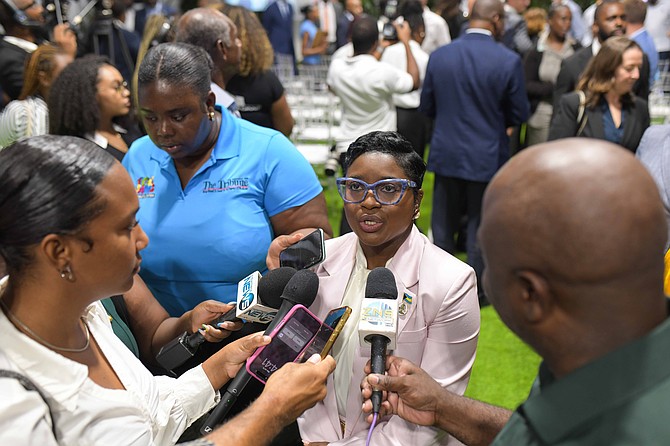
ENERGY, Utilities and Aviation Minister JoBeth Coleby-Davis
By FAY SIMMONS
TRIBUNE Business Reporter
jsimmons@tribunemedia.net
A CABINET minister yesterday said The Bahamas cannot afford to delay its energy transition while households and businesses remain exposed to volatile international fuel prices.
Jobeth Coleby-Davis, minister of energy, utilities and aviation, told the 2026 CARILEC Resilient/Renewable Energy Community conference and exhibition Minister of Energy, Utilities and Aviation that renewable energy and institutional reform are critical to improving electricity affordability and security.
She added that small island developing states such as The Bahamas and wider Caribbean face a choice between continuing to absorb the costs of imported fossil fuels and deliberately diversifying their energy supplies.
“Small island states are often told that the energy transition is too expensive for us. The evidence says it is too expensive to wait,” Mrs Coleby-Davis said.
She argued that rising oil prices translate into higher electricity costs for households and operating expenses for businesses, leaving Caribbean economies vulnerable to developments beyond their control.
Mrs Coleby-Davis said the Bahamas' ‘New Energy Era’ was designed to address that exposure through renewable generation, battery storage, modernised electricity infrastructure and institutional reform.
The Government is targeting renewable energy to meet 30 per cent of The Bahamas’ electricity requirements by 2030, supported by approximately 60 mega watts (MW) of utility-scale solar generation, battery storage and upgrades to the generation fleet.
But Mrs Coleby-Davis warned that renewable energy projects alone will not be enough to transform the electricity sector, arguing that investment must be accompanied by stronger institutions, clear policies and effective regulation.
“We cannot modernise generation while leaving our networks behind,” she said. “We cannot attract investments without sound regulation, and we cannot deliver lasting reform without institutions capable of sustaining it.”
Mrs Coleby-Davis said the Government is also investing in digitisation and advanced metering with support from the Inter-American Development Bank (IDB) as part of wider efforts to modernise the electricity sector.
Natural gas will also play a role in the transition, with Mrs Coleby-Davis defending its introduction as a means of reducing dependence on more expensive petroleum fuels while maintaining reliability as renewable capacity expands.
“Natural gas is a bridge, not a destination,” she added. Acknowledging concerns about the role of liquefied natural gas (LNG) in the energy transition, Mrs Coleby-Davis argued that continuing to rely on petroleum fuels will leave The Bahamas exposed to higher costs and emissions.
“Waiting for a perfect solution means Bahamian households pay for the delay,” she said, adding that the Government's renewable energy ambitions remained the destination. The strategy is being applied differently across the country, with the Government pursuing projects designed around the needs of individual islands.
On Grand Bahama, Mrs Coleby-Davis said 9.5 MW of solar generation is already operating through an independent power producer (IPP) arrangement, with another 5 MW under construction.
She also pointed to plans to advance the integration of Grand Bahama Power Company into a more co-ordinated national framework through the Grand Bahama Energy Company.
In Abaco, the Government is advancing a 27 MW hybrid microgrid combining solar generation, battery energy storage and new LNG generation, with full commissioning targeted for spring 2027. The EA Energy project is intended to combine the reliability of firm generation with an increasing contribution from solar power and storage.
Mrs Coleby-Davis cited the estimated $3.4bn in damage and losses caused by Hurricane Dorian in 2019 as evidence of the need to build electricity systems capable of withstanding severe weather, particularly in vulnerable Family Island communities.
On Eleuthera, the government is advancing a 20 MW hybrid microgrid also targeted for commissioning in 2027 and again with EA Energy as the private sector partner and producer.
Mrs Coleby-Davis argued that the different projects reflected the need for a national energy strategy that can accommodate the distinct electricity demands and infrastructure requirements of individual islands.
Beyond infrastructure, she said the success of the transition will depend on credible long-term planning, regulatory frameworks that provide clarity for investors and protect consumers, and investment in the engineers, operators, planners and regulators needed to operate modern electricity systems.
Mrs Coleby-Davis pointed to Uruguay, which generates more than 90 per cent of its electricity from renewable sources, as an example of how sustained policy, private investment frameworks and strong public utilities can support a successful transition.
She also called for greater co-operation among Caribbean countries, arguing that regional utilities can accelerate progress by sharing technical expertise, policy experience and lessons from past projects.
Mrs Coleby-Davis said the message to regional stakeholders was that countries facing similar challenges can achieve more by working together than by attempting to address them independently.
“All of us want to inspire that reliability, sustainability, affordability, but the transformation that incorporates the resiliency and the renewable sector that we benefit from as our natural resources,” she said.
The minister cited the deployment of Bahamian utility engineers to assist Jamaica with rebuilding efforts following Hurricane Melissa as an example of regional co-operation in practice.
Mrs Coleby-Davis said Caribbean countries can learn from one another's experiences, including what had worked, what had failed and which approaches might be suitable for their own electricity systems.
She urged delegates to move beyond policy commitments and focus on implementation, arguing that the ultimate measure of energy reform must be the improvements experienced by households and businesses.
“The New Energy Era must be measured not by the infrastructure we built, but by the improvements the Bahamian people experience,” the minister said.




Comments
Use the comment form below to begin a discussion about this content.
Sign in to comment
OpenID