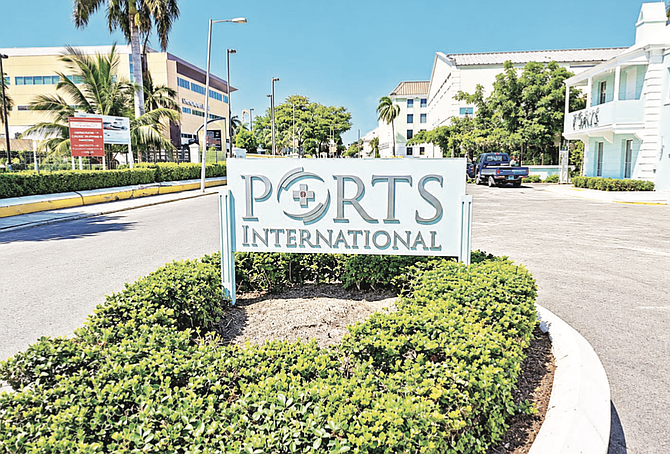
Ports International
By RASHAD ROLLE
Tribune News Editor
rrolle@tribunemedia.net
TWO men in charge of the estate of Mary Carolyn Papai, the late founder of medical supplier Ports International, were wrong to treat $500,000 she left to a church and four other organisations as void, a Supreme Court judge has ruled.
Papai, who wished for her ashes to be placed at a columbarium linked to New Providence Community Church, left the church $300,000. Twelve years after her death, it has received nothing.
Her executors, Ronald Harcourt Knowles and Charles Wenzel Mackay, refused to pay because the will said the gifts should come from her personal accounts and from Ports’ accounts. They argued she had no personal account when she died, and that the company’s money was not hers to give away.
Justice Hope Strachan agreed that the company’s money did not belong to Papai, but ruled that this did not wipe out the gifts. She found they were “demonstrative” legacies, meaning gifts of a fixed sum of money with a named source to be used first. When that source is empty or cannot lawfully be touched, the shortfall is paid from the rest of the estate instead.
Justice Strachan said: “A failed source does not necessarily mean a failed gift.”
The ruling, dated October 20, also covers a $50,000 gift to the Cancer Society of the Bahamas and a $150,000 fund to be held on trust for Smile Train, World Vision and Youth Empowerment through Soccer. Both were written in the same terms as the church’s gift.
The judge illustrated the difference with two examples. A gift of a particular item, such as a gold watch left to a daughter, fails if the watch no longer exists when the person dies. A gift of £5,000 to be paid from a savings account does not. If the account holds only £2,000, the remaining £3,000 can come from other estate assets.
Papai founded Ports International in 1987. According to the company’s website, it imports and wholesales medical, surgical, pharmaceutical and public safety supplies, and counts the Ministry of Health and the Public Hospitals Authority among its main customers.
She signed her will on February 4, 2014, and died on October 21 that year. Mr Knowles and Mr Mackay were granted probate in August 2015.
The will left all her shares in Ports and HMH Enterprises Ltd to trustees for her son until he turned 35, and then to him outright. It also left him her Sandyport properties and whatever remained of the estate after the other gifts. The executors said they were obliged to preserve the company’s value and pass its shares undiluted to his trustees when he turned 35 on October 15, 2023.
In letters dated August 10, 2020, and December 3, 2021, the executors rejected the church’s claim. Among their reasons, they cited the church’s failure to provide the cost of the proposed columbarium and details of other donors and how much they intended to give. The church sued in October 2022. It also sought a full account of the estate and alleged that the administration may have favoured the son over other beneficiaries.
Justice Strachan said the will imposed no such conditions and the executors had no right to add them. The gift contained no words such as “provided that”, she said, and the court could not invent a condition simply because it might explain why Papai wanted to benefit the church.
On the company’s money, the judge sided with the executors. Owning shares does not make a company’s bank accounts the shareholder’s property, she said, and they were right not to withdraw Ports’ funds merely because the will mentioned them. Papai’s own will made the trustees’ powers over Ports subject to decisions of the company’s board.
However, the judge said the estate must disclose any dividend or other payment it actually received from Ports or HMH.
She also refused to accept that Papai had no personal account. The probate declaration recorded bank deposits as nil, but then listed $49,153.24 at Scotiabank and $820.31 at Royal Bank. It put the estate’s total value at $96,067, including $40,000 in household goods, her Ports shares at $1,000 and her HMH shares at $5,000. Justice Strachan said those entries needed explaining before the executors’ position could safely be accepted.
She ordered Mr Knowles and Mr Mackay to file a full inventory and account of the estate within 45 days, setting out every asset, receipt, debt, expense and payment. They must reconcile the bank entries and produce banking records where available. They must also explain a $93.45 gap between the listed assets and the stated total, which matches a credit card balance in the declaration. In addition, they must disclose the value and fate of the Sandyport properties and the shares, any dividends received since Papai’s death, and any transfers or advances made to or for her son.
The ruling does not mean the church will be paid in full, or soon. Justice Strachan refused its request for an immediate order for the whole $300,000, saying the face value of a gift and what an estate can actually pay are different things. Once the account is filed, the court will work out how much of each gift can come from the named source and apply the legal order in which estate assets are used. It will then decide whether the gifts must be reduced.
She made no order for the sale of the Sandyport land or the shares left to the son, but said they would not be immune if the estate eventually reached that stage.
Whether the executors breached their duties, whether the son was improperly favoured and whether they are personally liable will be decided later. A mistaken reading of a will does not automatically make an executor personally liable, the judge said, and she found no fraud, dishonesty, bad faith or wilful default.
The church was awarded its costs on the main question of whether its gift was valid. Its claim for interest was put off until the amount owed, and the date it should have been paid, are known.
Norwood Rolle represented the church. Owen Wells represented the executors.




Comments
Use the comment form below to begin a discussion about this content.
Sign in to comment
OpenID