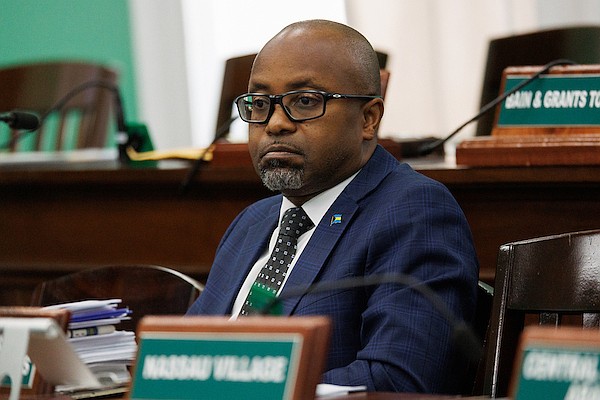
East Grand Bahama MP Kwasi Thompson speaks in the House of Assembly on July 30, 2025. Photo: Dante Carrer/Tribune Staff
By NEIL HARTNELL
TRIBUNE Business Editor
nhartnell@tribunemedia.net
THE GOVERNMENT’S failure to explain how it earned “$127m” in interest and dividends from typically loss-making public corporations casts “a cloud of secrecy” over its touted $39.3m Budget surplus, the Opposition’s finance spokesman charged yesterday.
Kwasi Thompson, the east Grand Bahama MP, returned to the attack on the 2025-2026 fiscal year outcome by also arguing that “every Bahamian should be distressed” at the amount of taxpayer monies being “masked” as loans, rather than treated as the subsidies they are, in propping up loss-making state-owned enterprises (SOEs).
The Davis administration’s June 2026 report revealed a further $131.7m in “bilateral short-term loans” were made by the Government to multiple public entities in the 2025-2026 fiscal year. Mr Thompson, though, said many are simply unable to repay these advances because they have no revenue or income-generating ability, making them subsidies disguised as loans to keep them off the books.
He asserted that, when the dividend income and “masked” subsidies are added to the near-$311m spent from accounts carrying the National Investment Fund’s name, which the Opposition argues should be included in the annual fiscal numbers because it represents traditional government capital expenditure, The Bahamas is likely facing “a significant deficit as opposed to a surplus”.
“The issue I raised was really one of transparency where they declared these dividends but didn’t give any further details on the corporations these dividends were issued from,” Mr Thompson told Tribune Business following the House of Assembly’s morning session.
“It again adds a cloud of secrecy and undermines the credibility of the Government and undermines the credibility of this so-called surplus.” Mr Thompson had asked the Davis administration to identify which public corporations paid dividend and interest income to the Public Treasury; how much each contributed; and whether these were generated from operating profits, these entities’ reserves or the Government settling outstanding bills and arrears it owed to them.
The Ministry of Finance’s report for June 2026, which also includes the full-year figures, appears to suggest that the Government’s settlement of payment arrears was returned back to it as dividends by the recipient public corporations to produce the surge in both revenues and spending.
“Movements in both revenue and expenditure included significant reciprocal offsets of receivables and payables between the Government and statutory bodies, together with sizeable dividend receipts,” the report said.
Breaking down the revenue and spending impacts, the Ministry of Finance added: “Non-tax revenue more than doubled by $159.8m to $206.6m [for June]. This outcome included significant gains in dividend income from several public entities, a significant portion of which was used to settle the government’s payment arrears.
“Payments for the use of goods and services rose more than two-fold by $193.3m being associated with higher outlays for utilities and communications.” That represents the payment of outstanding bills owed by government ministries, agencies and departments to the public corporations.
The dividend receipts produced a more than seven-fold jump in ‘other’ non-tax revenue, from $23.3m in June 2025 to $172.8m, while on the spending side, the Government’s outlay on goods and services increased more than four-fold in June 2026, rising year-over-year from $61.8m to $255.1m.
This played a key role in producing the more than five-fold year-over-year increase in the Budget surplus for June 2026 - from $25.4m in 2025 to $130.7m this time around. And, in turn, the month’s outcome was critical in bringing the Davis administration in almost $7m ahead of its revised $32.7m surplus at $39.3m.
Mr Thompson, meanwhile, told this newspaper yesterday that the Government has yet to address repeated concerned voiced over its apparent use of ‘loans’ to keep what are subsidies to loss-making SOEs, with no ability to repay these advances, outside the Budget calculations so they do not add to the deficit or national debt.
These loans can be treated as an asset, or investment, under the Government’s modified cash basis of accounting, and the east Grand Bahama MP argued that it should be “distressing” to all Bahamians that total taxpayer exposure to these advances now stands at $728.7m following the further $131.7m, or 22.1 percent, increase during the 2025-2026 fiscal year.
“This issue, it has been raised on a number of occasions but never addressed by the Government - the loans made to public entities that never had the ability so, essentially, it masks a subsidy by calling it a loan and, if you do that, it never appears in the Budgeting,” Mr Thompson argued.
“It again creates a huge issue for us because we continue to increase the amount of monies, whether we call them subsidies or loans, they are all the same. They are financial assistance provided to public corporations. We continue to increase the amount of money paid to public entities, and that should be distressing for every Bahamian.
“The long-term goal should be to put these entities in a position where they are self-sufficient.” Mr Thompson cited the Public Parks and Beaches Authority as a particular example, noting that it owes the Government a $10.9m loan as at end-March 2026 yet, at the same point, had exhausted its $29m subsidy for the full fiscal year with three months left and has no income-generating ability.
“The more significant point on the surplus, or simply where there is really no surplus, if you look at the amount spent through the National Investment Fund, when you look at the dividends paid where we have no idea from which corporation, and look at what expenditures should be made as subsidies but are marked as loans - if those amounts were portrayed as they should have been, as subsidies - you really would not have had a surplus,” the Opposition finance spokesman argued.
“If you look at the entire picture with the Government, the entire fiscal position of the Government, we really would have a deficit position as opposed to a surplus. The Government should not tout this as any kind of accomplishment, and they need to come back to then people to explain this and be far more transparent than they are.
“If the entire picture is put to the Bahamian public, we may find we are in a significant deficit as opposed to a surplus if the entire picture is placed before the public.” If it is correct that the near-$311m National Investment Fund outlay, together with the $131.7m in SOE ‘loans’, should have been included in the Budget figures, this $442.6m combined spending would convert the $39.3m surplus into a $400m-plus deficit.
Mr Thompson had earlier told the House of Assembly that the near-$127m he said the Government received in interest and dividend income from the unidentified public corporations was more than three times’ the full-year $39.3m surplus for 2025-2026 and critical to the overall outcome.
However, he added: “The report fails to indicate which public entities made these payments, how much each contributed and whether this came from actual operating profits, accumulated reserves or settlement of outstanding government obligations….
“There’s another issue with respect to the $39.3m surplus that I believe deserves an explanation. The Government announced a significant increase in interest and dividend income, almost a $127m increase, from the corporations.
“If the Government is receiving dividends from public corporations, and treating these dividends as revenue, shouldn’t it be looking at how much money the Government is lending or advancing to these corporations? As an accounting principle, when you deal with Budget expenditure and revenues, surpluses and deficits, you look at dividends coming from the public corporations and count them as revenue. But if you are loaning monies to these corporations….”
Mr Thompson was then interrupted by an intervention from Chester Cooper, deputy prime minister and minister of education, science and technology, who argued that he was “basing his conclusion on an erroneous premise” that the dividends were coming from loss-making SOEs and urged him to put his questions in writing.
The east Grand Bahama MP, voicing doubts that he will ever receive an answer from the Government, said: “The point is, if the Government is receiving dividends from public corporations, and accounting for these dividends as revenues, should we not be looking at what government is loaning and advancing to these same corporations?
“Why continue to look at one side of the books and ignore the other side? Why is the Government lending monies to public entities that have no reliable ability to pay these loans? If the Government has a mechanism to provide assistance to public entities it’s through subsidies.
“Subsidies are recognised in the Budget. You do not take account of the loans the Government provides to these public entities. Why are you providing loans to a public entity that has no ability to repay the loan? It’s the same as providing assistance but you are marketing it as something different,” Mr Thompson added.
“When you lend money to someone there must be a reasonable expectation they will pay the money back. It’s not a loan… It’s financial assistance.” The latter, Mr Thompson added, represents a subsidy that would be accounted for and included in the Budget as funds “to keep a public entity operating.
Citing the Public Parks and Beaches Authority, Mr Thompson asserted: “Let’s be practical. Let’s be real. Where is Beaches and Parks supposed to find $10.9m to repay the Government” especially given that its $29m subsidy for the 2025-2026 fiscal year was exhausted after the first nine months.
He argued that this also applies to the Broadcasting Corporation of The Bahamas (BCB) and Public Hospitals Authority (PHA), which have also received loans from the Government yet were “never established to make substantial profits” and lack the means to repay them.
“Why are we recording money advanced to them as loans without ever explaining how those loans will be repaid?” Mr Thompson asked. “I understand there is an accounting distinction between loans and subsidies. I am suggesting that every loan automatically be classified as an expense.
“If there is no realistic prospect of payment, the Government must account for these as, in reality, we are loaning money and it is a subsidy.” Mr Thompson branded the $39.3m Budget surplus for 2025-2026 as “non-existent”.




Comments
Sickened 2 hours, 15 minutes ago
All we do is borrow money and fund government corporations (i.e. BPL, BTC etc.) but yet we somehow have a huge investment somewhere that is paying us $100 million in dividends? If these corporations can pay huge dividends then they must be making money and don't need continued funding from government. Or are we lending them money so that they can pay us a dividend? Make it make sense.
Sign in to comment
OpenID