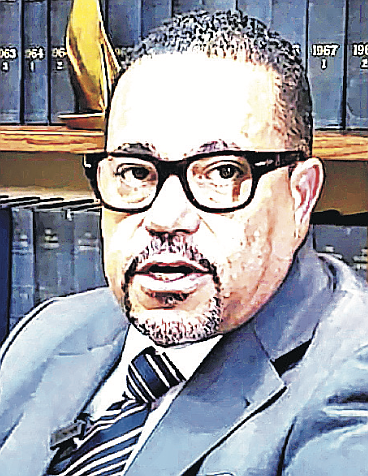
Thomas Dean
By NEIL HARTNELL
TRIBUNE Business Editor
nhartnell@tribunemedia.net
A GRAND Bahama attorney is backing the Government’s Freeport reform drive because The Bahamas cannot afford “a principality that doesn’t work”, describing the city as “failing” despite being “the largest foreign development in the country”.
Thomas Dean, a Freeport-based lawyer with Dupuch & Turnquest, told Tribune Business the strategy and consultation process unveiled by Prime Minister Philip Davis KC would “not be a topic of discussion for anyone right now” if The Bahamas’ second city, which has the infrastructure to support up to 250,000 persons, was “working” and achieving its full potential.
Arguing that “the status quo has not worked for 20 years”, he argued that change is long overdue and that it is “high time to judge” those responsible for Freeport’s development - the Grand Bahama Port Authority (GBPA) and its owners, the Hayward and St George families, plus senior management, who are unelected and thus not easily held accountable for any failings.
Mr Dean also sought to reassure the GBPA’s 3,500-plus existing licensees that any reforms, which could include repealing and replacing certain provisions, to the Hawksbill Creek Agreement will almost certainly not involve stripping them of the existing rights, benefits and concessions they enjoy under Freeport’s founding treaty.
Arguing that such a move would be “highly illegal”, and almost certain to face legal challenge, he told this newspaper that it would “be absolutely counter to what needs to happen here” given the desire to inspire greater business and investor confidence in Freeport and the wider island so as to spark increases job-creating projects.
“I don’t think that they can do otherwise,” Mr Dean told Tribune Business of preserving licensees’ existing rights under the Hawksbill Creek Agreement. Asked whether the Government will ensure these are maintained, he replied: “I have ultimate confidence they will, because it would be highly illegal if they were stripped.
“The Government will never take a retroactive view on the legal rights of any business to dilute them, adulterate them or penalise them. That would be absolutely counter to what needs to happen here. I don’t see that being a possibility.”
The Davis administration leapt to the defence of its reform package for Freeport, and wider Grand Bahama, on Friday after Herschel Walker, the US ambassador to The Bahamas, accused it of sending the message to investors that “the rules can change after you have already the investment” with its proposal.
Responding to the Government’s plans to seize control of Freeport’s governance, management and administration back from the GBPA, even though the Hawksbill Creek Agreement still has 28 years left on the original deal signed in 1955, Mr Walker said he read the announcement with “real concern” and urged that “existing commitments” to licensees and investors be honoured by any reforms.
This immediately flushed out Senator Latrae Rahming, the Prime Minister’s communications director, who in a video message issued on Friday pledged that the protection of investors and their investments, as well as their “vested rights” and existing contracts and benefits, will be “addressed” in any changes that occur.
“The Prime Minister gave assurances in his speech,” he said. “First, change will be be lawful. It will come through Parliament and other legal steps that the law requires, and only after consultation. Second, nothing will be done retrospectively. Vested rights, contracts, the protection of investors, investments, will be properly addressed.
“Third, licence holders’ lawful rights will be identified, recorded and respected. Licence holders will have a full say in how any change was made. Fourth, investors will have certainty the law will be clear and published, with transparent decisions and lawful procedures open to anyone. As the Prime Minister put it, certainty is the strongest incentive any country can offer.”
Mr Rahming also promised that the transition to whatever new governance regime for Grand Bahama emerges “will be orderly”. He added: “Services will continue throughout, and the responsibilities, staffing, funding and systems will be in place before any function moves…
“Many of the voices in this debate say they want a modern framework that makes it easier to do business in Grand Bahama. So does the Government.” Neither Mr Rahming nor the Government’s ‘Green Paper’ on the proposed Grand Bahama reforms gave an absolute guarantee that all existing GBPA and investor rights, benefits and incentives will survive the transition to a new regime.
“Savings and transitional provisions will give residents and businesses an explicit account of the continued validity of existing permissions and the handling of cases already under consideration,” the ‘Gren Paper’ said. “They will address fees already paid or accrued, service obligations crossing the commencement date and the custody and use of records.
“The Government will identify the legal interests affected by each reform measure, including property, leases, contractual obligations, licences, concessions, employment responsibilities, security arrangements and pending claims. The review will distinguish interests that can continue under savings provisions, interests requiring variation and issues requiring another form of lawful treatment.”
One other Grand Bahama attorney, speaking to Tribune Business on condition of anonymity, also hailed the Prime Minister’s move for change and said most GBPA licensees are likely to be neutral so long as their existing rights, benefits and investment terms are protected and sustain.
“I think it’s a good move,” they said. “I called clients in Freeport today, and they said: ‘Once we get the benefits we don’t care who’s in charge’.” The attorney added that existing investment laws, such as the Hotels Encouragement Act, provide benefits comparable to the Hawksbill Creek Agreement and current Freeport businesses can be switched to these regimes if needed.
“The free trade zone concept has been like a marketing point rather than a substantive point,” they said of Freeport’s business model. “They [the Government] can give it under the Hotels Encouragement Act, the Industries Encouragement Act. You have the same benefits; everything that’s there under the Port Authority, and you’re not restricted to driving your bonded car in Freeport.
“The ones who are against this are the ones who are making money. Everyone wants to leave Freeport. The place is dying and something needs to change. If the Port Authority doesn’t do something, the Government needs to step in and try something.”
This was echoed by Mr Dean, who told Tribune Business: “I think that it is clear what needs to happen. I would go so far as to say the status quo for the city has not worked for 20 years. We need change. It’s high time to judge persons who work for us, are employed by us.
“We need to be able to judge their performance and terminate their performance if they are found wanting. That applies to any government regardless of affiliation. The licensees and people of Grand Bahama need more. We need the natural laws and supply and demand to function here.”
Mr Dean signalled that, rather than successive government administrations in Nassau, the majority of blame for Freeport’s economic and social stagnation since 2004, the year that the city lost critical mass with the Royal Oasis closure that took away 1,200 jobs, lies with the entity charged with its governance and development - the GBPA, and its owners and management.
Noting that, unlike a government, Freeport residents and licensees are unable to vote their quasi-governmental authority in or out of office, and hold them to account, the Dupuch & Turnquest attorney asked: “When have you last voted for any of the Board of Directors?”
The Government’s broad-brush proposal involves replacing what it views as a Freeport-centric governance model, via the Hawksbill Creek Agreement, with an island-wide framework and regime under the planned Grand Bahama Development Act. Its implementation would be monitored and co-ordinated by a Grand Bahama Development Council.
Mr Dean, revealing worries about who will serve on such a body, said: “My one concern.. I have a great concern that we need to ensure the proper personalities, intellect and talent are put in place to get the job done right.”
Nevertheless, he told this newspaper: “I think it’s something that has to happen whether we like to admit ourselves or we don’t. The issue is that we cannot have a principality that doesn’t work. If it was working this would not be a discussion for anyone now. The issue in Grand Bahama is those who don’t want it to change are enjoying the benefits of their share of the pie….
“Grand Bahama is the largest single foreign development in this country. It has failed. The question we need to ask is why it has failed and let’s change it. This is not partisan politics that I am playing. I couldn’t care less about political alliances or groups. This is about the licensees and residents and those who want to make the place function. It’s about nothing more than that.”
Mr Dean said Freeport’s benefits are not trickling down to regular Bahamians, but added that non-Bahamians are critical to the city and island’s future as it will “not be developed or built to any sustainable mass by Bahamians only. We need to attract the best and brightest from the world to come”.
He later sent Tribune Business a video recording in which he cited Freeport’s untapped potential that can benefit the entire Bahamas.
The Dupuch & Turnquest attorney described the city as “the only place I see a viable chance to immediately expand the revenue base of the country to ensure there are opportunities for Bahamians, and to stop what I consider to be the rot of a city that has more promise than anyone [anywhere] else or any other island”.
“I hate to say it but, suffice to say, it probably can’t get any worse in the city of Freeport today, and that is a sad testament as to where we are,” Mr Dean said. “This is a necessary reform, and I commend the Prime Minister for doing it. This is the first time someone has taken a true attempt for righting a wrong that has been here for a very long time.
“I’m hoping the average Bahamian has now realised it’s not the Government of The Bahamas to blame for the demise of Freeport. It’s those in charge. It was those in charge, to which they are obviously in dereliction of their duty…. Let’s be honest. This is a company town, and the company has failed the town. I’m not saying that in any which way to be caustic. I’m saying that is the commercial reality.”
Mr Dean also questioned why no major resort or residential development has yet to exploit the 40-50 miles of “clear, free title” land on the beachfront”.




Comments
Use the comment form below to begin a discussion about this content.
Sign in to comment
OpenID