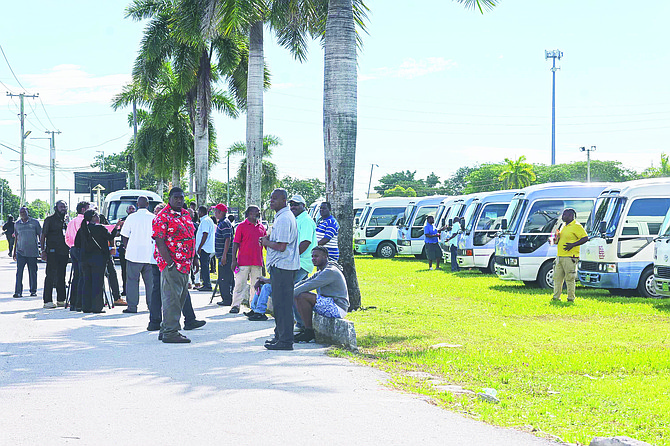
BUS operators park their buses at RM Bailey Park yesterday as they strike to demand higher fares. Photo: Chappell Whyms Jr
By LYNAIRE MUNNINGS
Tribune Staff Reporter
lmunnings@tribunemedia.net
COMMUTERS were left stranded at bus stops across New Providence yesterday after bus operators pulled their vehicles off the road to demand a higher fare, warning they will take further action if talks with the government on Friday fail.
Operators want the standard adult fare raised from $1.50 to $2, saying rising fuel prices and operating costs have made the service unsustainable.
An official estimated that more than 100 buses were represented at the protest at RM Bailey Park, where drivers from different routes gathered, although some operators left their buses at home and travelled there by car or with others.
Passengers reported waiting an hour or longer at bus stops, with little to no service on some routes. Although a few buses stayed on the road, many commuters struggled to get to work, school and other daily commitments.
The stoppage compounded the disruption on New Providence’s roads, which have seen closures and diversions for King Charles III’s motorcade since his arrival on Tuesday, when major roads and intersections from Lynden Pindling International Airport through western New Providence, downtown Nassau and Paradise Island were closed or restricted.
“If that meeting is not successful,” said Harrison Moxey, president of the United Public Transportation Company, “then we believe that we will have to take further steps to make our petition known, and we’re prepared to do whatever it takes.”
Transport Minister Leon Lundy later said services would resume at 3pm after discussions with industry leaders, who agreed to avoid further disruption ahead of the meeting, set for 1pm on Friday.
Earlier in the day, Mr Lundy said the ministry had already received and responded to an industry proposal and had arranged Friday’s meeting.
“With that process already underway,” he said, “today’s industrial action is particularly disappointing and does little to support the spirit of good-faith negotiations that we believe is necessary to reach a resolution.”
He acknowledged the operators’ concerns but said the thousands of Bahamians who depend on public transportation should not have to bear the consequences of the dispute.
Ezra Strachan described the action as a “sick day” rather than a strike. He apologised to commuters, including regular passengers who rely on familiar drivers to get around, but said operators also had families, children and bills to pay.
He said drivers were regularly called on to support major national events and political campaigns, pointing to the King’s visit, but faced delays when they sought meetings about their own financial pressures.
“We need to actually have some issues that need to be addressed, and we need some results, not just talking it. We need some options to be shown,” he said.
Mr Moxey said operators had reached “the point of the straw that has broken the camel’s back” after years of financial strain and repeated attempts to get the government to act. He said operators sent a letter outlining the industry’s concerns about fuel prices and inflation to the Ministry of Finance in June, but never received a satisfactory response.
He said bus owners and drivers were effectively subsidising public transportation by absorbing ever-rising costs, citing a driver who earned $126 on Tuesday but needed about $130 to refuel the bus for the next day.
Mr Moxey asked: “How do we go home every day with our financial obligations, with our bank loans, with our mortgages, experiencing the same inflation that the country has experienced?”
He said operators wanted to meet Mr Lundy directly rather than through intermediaries, because the minister was responsible for transport policy and sat at the Cabinet table. A meeting scheduled for Tuesday had not materialised, he said, and operators had been frustrated by the lack of a confirmed date and time until Friday’s meeting was arranged. He said they had faith it would go ahead.
The standard adult fare rose by 25 cents to $1.50 on May 1, 2024, the first increase in 16 years. Operators say costs have overtaken that rise and that a $2 fare had previously been promised to them.
John Hepburn, a bus driver for more than 30 years, said fares had gone up by only $1 in all his time in the business. He said fuel now cost more than $8 a gallon and that filling a bus had climbed from about $20 when he started driving to between $150 and $160 a day, while some parts had doubled or tripled in price over the past five years.
He said operators needed the increase to maintain a safe, reliable service, and pointed out that they had not asked for higher fares for senior citizens or primary schoolchildren.
Rudolph Taylor, president of the Bahamas Unified Bus Drivers Union, said the frustration had been building for years and was not simply a reaction to recent fuel prices. He said his last meeting with a transport minister and the minister’s team was in 2024, and that operators had repeatedly raised their concerns in letters and discussions without getting meaningful answers, including whether fares would keep pace with the cost of living.
He said tyres that once cost about $140 now cost $190, a bucket of oil had risen from about $120 to $175, and brake parts had gone from about $40 to between $60 and $70.
Mr Taylor said drivers did not want to strike because they understood the hardship it caused the public, but questioned whether operators were appreciated for the hours they worked. Some drivers worked Monday to Sunday, he said, and operators also needed time to rest and look after their health.
In a second statement, Mr Lundy said Friday’s meeting would go beyond fuel prices and operators’ finances to cover road safety enforcement, compliance with public transport regulations and codes of conduct, possible changes to bus routes and the potential resumption of a pilot programme for a more centralised public bus system, with scheduled services and better coordination between routes.
Successive governments have tried for decades to unify New Providence’s privately owned jitney routes into a single scheduled system, with several pilot projects backed by the Inter-American Development Bank announced since the 2010s.




Comments
Use the comment form below to begin a discussion about this content.
Sign in to comment
OpenID