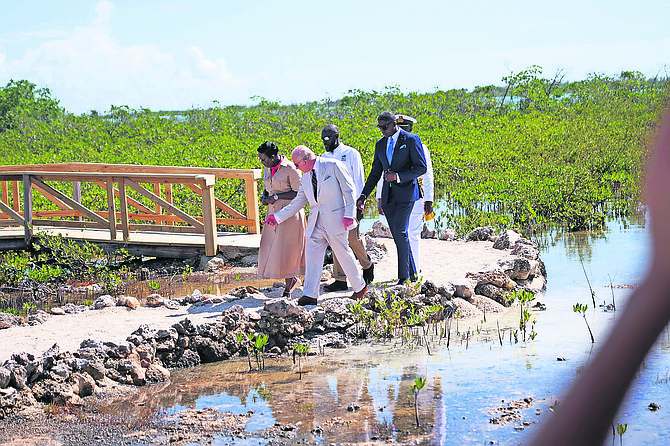
BNT xecutive director Lakeshia Anderson-Rolle walks alongside King Charles III during a tour of Bonefish Pond yesterday, where she said the king asked many questions. Photo: Nikia Charlton
By LEANDRA ROLLE
Tribune Chief Reporter
lrolle@tribunemedia.net
KING Charles III asked so many questions during his tour of Bonefish Pond National Park yesterday that the head of the Bahamas National Trust said he “partially led the tour”.
The King, who is patron of the BNT, quizzed conservationists about the park’s mangroves, the species that live among them and how the trees protect coastal communities from storm surges.
“To be quite honest, I would say he partially led the tour because the questions that he asked and what he inquired on was really in alignment to what the tour centered itself around,” BNT executive director Lakeshia Anderson-Rolle said.
Mrs Anderson-Rolle said one of the first things the King told the BNT team was that he was its patron.
“He recognised that he is actually the patron of the Bahamas National Trust and so that was one of the first things he said to us was that ‘yes, I’m happy to meet you all. I am the patron of the BNT’,” she said.
Bonefish Pond, on the southern coast of New Providence, protects 1,235 acres of coastal wetlands and is one of 33 national parks managed by the BNT. The park was created in 2002 on land that had been used as an illegal dumping ground, and it serves as a nursery for marine life.
Before the tour, the King, dressed in a grey suit and sunglasses, briefly greeted Environment Minister Zane Lightbourne, Housing Minister Keith Bell and Minister of State for Immigration Darron Pickstock and discussed matters related to their ministries.
He was then led through the park by New Providence parks manager Anwar Rolle. Local media were not allowed to accompany him on that part of the visit.
The tour included a stop at a pavilion at the end of the park’s 650ft boardwalk, where students from LW Young High School, Bahamas Academy, Anatol Rodgers High School and CV Bethel Senior High School were kayaking and snorkelling among the mangroves and observing the species living among their prop roots.
The King watched a demonstration of a withal collector, a device used to monitor species in the pond.
“So what His Majesty was able to view would be some of the species, some of the marine life that typically makes their way into the creek before they grow and move out onto the reef system,” Mrs Anderson-Rolle said.
She said the King was particularly interested in the students, asking how many visited the park and what activities they took part in. He also spoke with the head boy of Bahamas Academy, who was excited to meet him.
“He was really engaged, and so we were really excited to be able to show him firsthand one of the 33 national parks that has been entrusted to us to care for,” she said.
Representatives of the Perry Institute for Marine Science, the Bahamas Reef Environment Educational Foundation and the Bonefish and Tarpon Trust also took part.
The King helped unveil a plaque commemorating his visit, smiling afterwards, before planting a silver buttonwood, a tree associated with the mangrove ecosystem. It is one of three buttonwoods that will be planted in the area to mark the occasion.
Lindy Knowles, the BNT’s acting director of science and policy, told him the buttonwood grows closer to land and is one of the last lines of defence against the sea, helping to shield coastal areas from the effects of climate change.
The King asked whether the tree was resilient and how large it grew. Mr Knowles assured him it was hardy and showed him a fully grown buttonwood nearby. The King then scooped up soil and packed it around the newly planted tree.
Mr Pickstock said the park was worth protecting.
“It’s the last trove of mangroves in New Providence,” he said, “and so it’s important that we preserve this for future generations and so it is important for him to see, as he is the patron, what in fact is happening and what the BNT Bahamas National Trust is doing to preserve and protect the mangroves here.”
Conservation has been a central theme of the King’s three-day visit, his first to The Bahamas as monarch. Shortly after arriving on Tuesday, he told young people at Clifford Park that low-lying island nations were especially vulnerable to rising seas and other climate threats, pointing out that 90 percent of The Bahamas’ land sits less than two metres above sea level. He urged young Bahamians to help build a sustainable future, drawing on more than 50 years of work with young people across the Commonwealth.
Prime Minister Philip “Brave” Davis said the King’s interest in the environment was long-standing.
“He’s very interested in the environment,” Mr Davis said. “His voice was one of the first voices to warn about climate change and its consequences from way back in the early 70s and so he went to Bonefish Pond so he can see some of the actual evidence of how climate change is impacting our small island.”
Mr Davis said the visit had brought The Bahamas welcome international exposure, and that he had been getting calls from around the world about the King’s presence and the country’s hospitality.
Asked about the cost of the royal visit, he said he did not know the total. Foreign Affairs Minister Fred Mitchell has also declined to give a figure, saying only that the spending is appropriate and will not “break the bank”.
The King travels to Guyana today, then to Antigua and Barbuda for the Commonwealth Heads of Government Meeting from November 1 to 4.




Comments
Use the comment form below to begin a discussion about this content.
Sign in to comment
OpenID