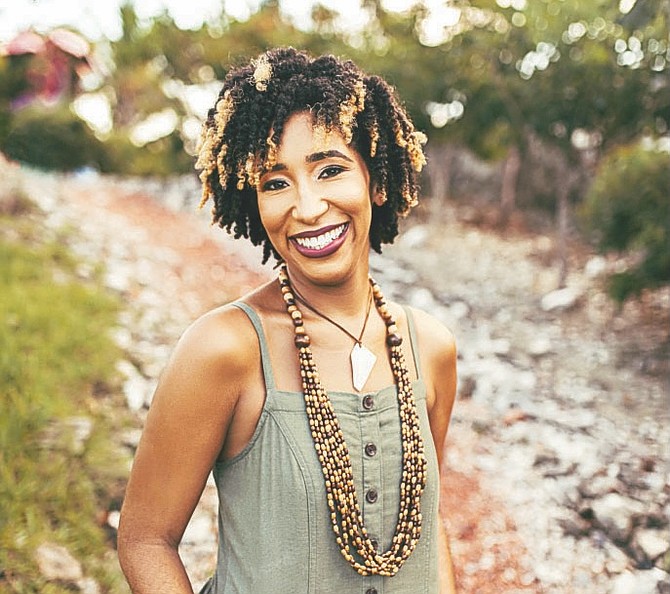
Alicia Wallace
By KEILE CAMPBELL
Tribune Staff Reporter
kcampbell@tribunemedia.net
WRITER and activist Alicia Wallace has condemned the staging of Junkanoo for King Charles III as an insult to the enslaved ancestors who created it, while cultural anthropologist Dr Nicolette Bethel said the real problem was not the performance but The Bahamas’ decision to keep the monarchy.
The King’s participation in Wednesday’s Junkanoo rush-out in downtown Nassau has divided cultural figures over the tradition’s roots in slavery, its place in Bahamian identity and what it means to perform it for the British monarch. Yesterday, junkanoo veteran Quinton “Barabbas” Woodside welcomed the King’s involvement but questioned why more Junkanoo leaders were not consulted.
Ms Wallace, whose social media post questioned the presentation of Junkanoo during the royal visit, told The Tribune the tradition grew out of the resistance of enslaved Africans and their descendants.
“A part of the rebellion was Junkanoo which still shows us today that our resistance against capitalism, slavery, and colonialism can be joyful,” she said. “It is not a commodity. It is not a minstrel show. It is ours to own, to feel, and to evolve.”
She said the government’s decision to present the tradition to the King insulted the ancestors who resisted enslavement and those who carried on that struggle. She tied her objection to continuing calls for reparations and a formal apology for slavery. Britain’s historical debt to people of African descent in The Bahamas and the wider Caribbean remained unpaid, she said.
“We cannot allow them to reduce Junkanoo to a show they can commission for foreigners, concealing its origin and meaning,” she said. “Our existence is not for their gaze. Our culture is not for their consumption. We owe them nothing.”
Dr Bethel, who said she had not watched the King’s participation herself, said viewing the occasion simply as ironic missed the deeper issue.
“I think that if we’re looking at it as an ironic situation, we’re missing the point,” she said. “Junkanoo is objectified on some level and commodified on another level, and I think we may approach it too lightly.”
She said there was nothing inherently wrong with the King joining in, or with Bahamians showing off their culture to him. Nor, she said, was it inherently contradictory to perform a tradition associated with resistance to slavery before the monarch. But Britain’s history gave the occasion political weight.
“There is a political and historical weight that is attached to his monarchy, to the monarch of Britain,” she said. “The problem is not the performance for me. The problem is our retention of the monarchy.”
Dr Bethel drew a distinction between Bahamians presenting Junkanoo as an expression of who they are and performing it as subjects putting on a show for their king. Bahamians regularly stage cultural performances for visiting celebrities, she said, and that was not a problem in itself. Wednesday’s event, however, was harder to read.
“I don’t know where I would put Wednesday’s performance,” she said. “It’s the intention, it’s the symbolism, it’s not the act itself that matters.”
She also took issue with claims circulated on social media before the King’s arrival that Junkanoo groups had been given guidelines on their behaviour, dancing and costumes for the royal performance. Performers should be trusted to keep the tradition authentic rather than tailor it to suit the monarch, she said.
“Because what is more important? The king or Junkanoo? For me, I think it should be Junkanoo. The king is a guest, in my opinion,” she said.
Mr Woodside, founder of the Junkanoo World Museum and Arts Centre, said Junkanoo leaders from across New Providence should have been involved in Wednesday’s celebrations. He said political leaders too often organised major cultural events without properly consulting the people who keep the tradition alive.
“We should have other leaders involved, so we can understand it better, so we can bring it into the community,” he said.
Asked about the irony of Junkanoo being performed for the British monarch, Mr Woodside said he had mixed feelings and argued that little had changed since the colonial era.
“I think our leaders treat us the same way that they treat our ancestors,” he said.
He said independence had not brought enough change in how Bahamians were treated by their leaders, and that the country should show greater independence in its decision-making.
Mr Woodside also distinguished between the traditional Boxing Day and New Year’s Day parades and paid performances for visiting dignitaries. The traditional rush-outs, he said, carry a spiritual connection that is not always present when groups perform for visitors.
“It’s the spirit in us,” he said. He described performers entering a trance-like state during the traditional parades, an experience he said was difficult to reproduce in shorter performances.
He said the King’s visit could have included stops at cultural institutions so he could learn more about Junkanoo’s history, including the experiences of the enslaved Africans from whom it emerged. He also suggested daily Junkanoo performances at airports and cruise ports to bring in more tourism revenue and create opportunities for cultural practitioners.
Junkanoo traces its origins to celebrations among enslaved Africans and is the country’s most recognisable expressions of national identity. UNESCO inscribed it on its Representative List of the Intangible Cultural Heritage of Humanity in 2023, the first Bahamian submission to be added to the list.
The rush-out formed part of a cultural festival at Parliament and Rawson Square, which the government presented as a celebration of Bahamian heritage. The King watched from the sidelines before stepping into the parade on Bay Street.
At the same event, Bahamas National Reparations Committee chair Dr Niambi Hall Campbell-Dean said police told her she could watch only if she put away her poster calling for reparations.
Dr Bethel said Junkanoo had not lost its political meaning as long as it remained a living expression of Bahamian identity. That could change, she warned, if young people stopped taking part and the tradition came to depend on staged performances rather than community participation.
“Is Junkanoo in the hands of enough children and young people to keep it alive? That’s the question we need to be asking,” she said.




Comments
licks2 14 hours, 26 minutes ago
My my my. . .don't they know that no slaves directly from Africa were brought into the Bahamas. . .except those that were brought from America after the Loyalists were kicked out of America with their Gulla Slaves? Before that migration, blacks were here as ship wreaked or rescued blacks from slave ships that were destined for locations further south!!
Making enslaved blacks work on plantations did not happen in New Providence. . .or other out islands until the Loyalists "tried" their hands at a few plantations throughout the Bahama Islands after leaving America to avoid living under the newly formed American Government following the break-away from Britian. Those few plantations did not last very long and the Loyalists went back to England and other places, leaving their black slaves free as jaybirds on out island plantations and a few in NP. And the few in NP lived in their own free villages such as Grants Town, Fox Hill, Adalaide and Gambier etc.
New Providence was never a slave holding station for any type of use for force labor like other Caribbean countries. Runaways and other rescued from other captured slave ships from all over the Caribbean and America were brought to New Providence and set free!
Since those few Loyalists tried and fail at "slavery" in the Bahamas. . .the Bahamas has never been a slave-holding state!! After 1834, the crown paid all slaveholders for each slave freed within the Caribbean but did not have to pay for black people living freely in the Bahamas!
The Gulla were long freed into various out islands and the runner ways from slavery and blacks resecured from slave ships were typically brough to New Providence. Africans in the Bahamas were not typically slaves. . .except Loyalists Gulla, who were slaves for a little while until the Loyalists gave-up on plantations in the Bahamas and left their plantations and Gulla slaves to themselves.
birdiestrachan 14 hours, 11 minutes ago
Also there would be no salvery.without.the parpation of other blacks who knew the lay of the land and showed the white people where the black people lived
birdiestrachan 13 hours, 48 minutes ago
Participate black people did. Perhaps the lesson to be learned is to unite and not to compete work together to make the Bahamas a better place
Sign in to comment
OpenID