By EARYEL BOWLEG
Tribune Staff Reporter
ebowleg@tribunemedia.net
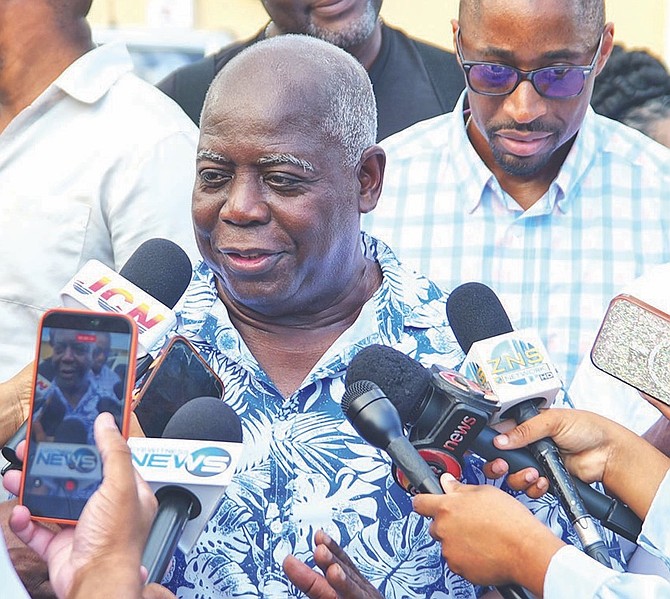
PRIME Minister Philip “Brave” Davis yesterday warned that small island states are paying a “sovereignty discount” in the global digital economy and urged them to unite around a common position on data, telecommunications infrastructure and regulatory control.
Mr Davis, speaking at the opening of the World Telecommunication/ICT Policy Forum 2026, said the challenge confronting Small Island Developing States goes beyond the traditional digital divide and extends to the leverage larger countries and companies hold when smaller states have few alternatives.
He described the “sovereignty discount” as the price a country pays in “every negotiation where the other side knows it has no alternative”.
The prime minister called for SIDS to adopt a unified five-point position covering data, control, resilience, satellite and spectrum policy and technical capability.
“Small Island Developing States have never yet arrived at a forum like this with a single position,” Mr Davis said. “We have arrived with grievances. With delegations. With hope. Never with a position. Let us change that here.”
He argued that although SIDS have small populations, their territorial and regulatory reach gives them greater collective leverage than is often assumed.
“We are not a small constituency,” he said. “We are a small population with an enormous jurisdiction.”
Mr Davis said the vulnerability of international telecommunications systems was particularly serious for island states, pointing out that more than 99 percent of international data travels through undersea cables and between 150 and 200 cable faults occur each year.
He cited Tonga, where a volcanic eruption severed the country’s undersea cable in January 2022, as an example of how quickly a nation’s connectivity can be disrupted.
The prime minister also focused heavily on the value generated from citizens’ data and the concentration of digital infrastructure and investment in wealthier economies.
“Data is a commodity now. Let us stop being delicate about it,” Mr Davis said. “It is collected, cleaned, priced, bundled and traded.”
He said citizens in developing states generate data continuously but much of the economic value derived from it is captured elsewhere.
“Our citizens produce it every hour of every day, and we supply it without an invoice,” he said.
Mr Davis said digitally deliverable services account for more than 60 percent of services exports in advanced economies compared with 15 percent in the least developed countries. He also said about 80 percent of new digital investment projects across the Global South are concentrated in just ten countries.
He warned that many developing countries also remain dependent on foreign digital infrastructure, with national data stored overseas and subject to laws beyond their control.
Mr Davis rejected the notion that small states must simply accept technological or commercial arrangements presented to them as inevitable.
“Inevitability is not a description of the future,” he said. “It is a demand about the present.”
He said such claims ask smaller states to stop negotiating and to accept another party’s preference as their destiny.
“It is a decision with the signature scraped off,” he said.
Under the five-point framework proposed by Mr Davis, SIDS would treat citizens’ personal data as a protected national interest and negotiate the terms under which it may cross borders.
“Data,” he said, should be protected “in our law and in our agreements”, with cross-border transfers negotiated rather than assumed.
He said where citizens’ data creates economic value, some of that value should return to the countries producing it through local processing, skills and revenue.
On telecommunications infrastructure, Mr Davis argued that countries do not necessarily have to own cables to exercise meaningful authority over them.
He called for enforceable landing rights, open-access obligations, licence conditions with real force and regulators capable of holding global companies to their commitments.
He also said telecommunications should be treated in law as critical national infrastructure, with redundancy and restoration requirements designed around the realities facing island states.
The Bahamas has meanwhile nominated Stephen Bereaux for the office of Deputy Secretary-General of the International Telecommunication Union, and Mr Davis appealed for support for his candidacy ahead of the election in Doha in November.
ITU Secretary-General Doreen Bogdan-Martin said the 2026 gathering is the seventh WTPF held in three decades and the first hosted by a Small Island Developing State.
Ms Bogdan-Martin said previous forums had grappled with major shifts including telecommunications liberalisation, global trade, IP telephony, internet governance and emerging technologies.
She said the sector has reached another turning point as artificial intelligence advances rapidly, space-based connectivity expands and questions of digital resilience and environmental responsibility become increasingly important.
Innovation and National Development Minister Sebastian Bastian, reporting on the main outcomes of the WTPF 2026 strategic dialogue, said one central conclusion was that resilience must be built into digital systems before crises occur.
He said that requires diverse and well-organised networks, reliable power supplies, infrastructure sharing, early-warning systems, trusted technologies and strong institutions.
Mr Bastian said governments, regulators and telecommunications operators must also establish arrangements for cooperation before disruptions take place.
He said the success of digital development should not be measured simply by whether people are connected, but by what that connectivity allows them to achieve.
“Connectivity is the foundation, not the final objective,” Mr Bastian said.
“The real test is what it enables — whether digital transformation strengthens resilience, expands opportunity and improves people’s lives.”




Comments
Use the comment form below to begin a discussion about this content.
Sign in to comment
OpenID