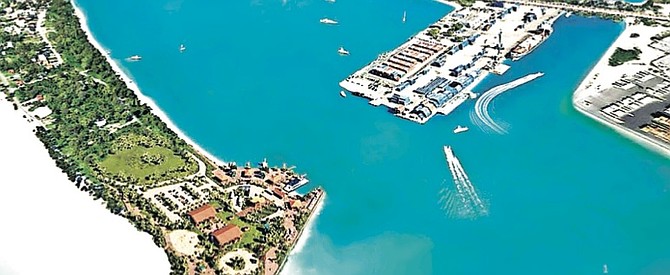
Bahama Rock Expansion
By NEIL HARTNELL
Tribune Business Editor
nhartnell@tribunemedia.net
A GRAND Bahama aggregate supplier is pledging to invest a further $9m to expand production and fill the void created by Bahama Rock’s temporary shutdown through servicing contractors and “all of the local needs in The Bahamas”.
Gregory Moss, attorney for Freeport Aggregates, revealed in a September 16, 2026, letter to Jobeth Coleby-Davis, minister of energy, utilities and aviation, that it is targeting the 2027 third quarter for completion of its planned capacity expansion which will create 20 new jobs in positions such as dragline operations, quality control technicians, maintenance technicians and fixed equipment technicians.
He added that the project, if it proceeds, will take Freeport Aggregates’ post-Hurricane Dorian investment to $19m - including $10m spent by the company on rebuilding its plant. However, Mr Moss’s letter signalled that the company needs to acquire additional land to facilitate its expansion, and meet The Bahamas’ domestic aggregate supply needs as well as export orders.
The document, which has been seen by Tribune Business, did not identify the property Freeport Aggregates is seeking to purchase but referenced previous correspondence with Mrs Coleby-Davis that is now being “reviewed” by the minister “in consultation with the Prime Minister Philip Davis KC”.
The letter, titled ‘Proposed purchase of land by Freeport Aggregates’, refers to correspondence submitted to the Government on August 24, 2026, and September 3, 2026, which was acknowledged by Mrs Coleby-Davis’s secretary on September 10, 2026. Mr Moss yesterday confirmed that the letters are authentic, but declined to comment further when contacted by Tribune Business.
However, Freeport Aggregates’ proposed expansion may provide some reassurance to Bahamian contractors who have previously voiced concern that Bahama Rock’s production halt - set to last an initial 60 days as it waits for government agencies to issue the necessary approvals for it to mine the 515-acre Bahamas Cement Company site - could result in shortages of aggregate and other building materials, thus driving construction costs even higher.
Mr Moss, signalling that his client is prepared to step into the breach, and ensure supply continuity, said it would initially relocate mobile “assets” from the US to increase existing output on Grand Bahama before replacing this with a “fully equipped” fixed plant set to be installed within the next 12 months. Freeport Aggregates, though, needs the “co-operation” of Bahamas Customs and Immigration on imports and work permits to make this happen.
“Further to our aforesaid letters, and pending your ministry’s further response, we wish to elaborate on our client’s ability and current initiatives to increase production in order to continue supplying limestone aggregates within The Bahamas,” Mr Moss wrote.
“Since 2022, after the destruction of our clients’ plant by Hurricane Dorian and the scourge of the COVID-19 pandemic, our client has completed a $10m capital rebuilding project. It has completely rebuilt its plant and has successfully supplied aggregates orders from its customers within Grand Bahama and throughout the Family Islands…..
“Our client has approved an additional $9m capital investment within The Bahamas to further enhance its production capacity, including a strategic relocation of portable assets from its US locations to The Bahamas in order to temporarily augment its immediate local production capacity, and the acquisition of additional fixed assets to fully increase and sustain the same during the course of 2027.”
Mr Moss signalled that this will enable Freeport Aggregates to meet all construction and development-related demand for aggregate throughout the entire Bahamas. “As a result of these ongoing investments, our client has positioned itself to satisfy the limestone aggregate demand in the short-term through the use of… temporary portable assets and, during the course of 2027, to fully augment the same with fixed assets to better supply such needs.”
This may ease fears that the loss of Bahama Rock’s production will cause supply shortages and price hikes, as suggested by that company itself, which asserted its closure would likely “double” aggregate costs in The Bahamas for the Government, businesses and citizens.
Bahama Rock, in a presentation made during the July 29, 2026, town hall meeting on its project, disclosed that The Bahamas requires more than 350,000 tons of aggregate per year while warning that the loss of its supply source would double the cost of such materials for the Bahamian construction industry and result in delivery costs per ton being “up to 150 percent higher” due to extra import-related expenses.
However, Mr Moss suggested that Freeport Aggregates will be able to meet all Bahamian domestic demand if it is able to expand production, thus alleviating any negative fall-out from Bahama Rock’s predicament.
“Upon completion of its capital project - targeted for the third quarter of 2027 - it is anticipated that our client will have established its fully-equipped plant with sufficient fixed capacity to service all of the local needs within The Bahamas, together with its present export capacity,” he wrote.
“As a part of this expansion, our client is now in the process of advertising with the Ministry of Labour in Grand Bahama to engage approximately 20 additional employees.” Freeport Aggregates’ vacancy notice to the Department of Labour’s public employment services manager, Simone Thurston, was attached to the letter to Mrs Coleby-Davis.
Tribune Business was yesterday able to confirm that 18 of the 69 hourly-paid Bahama Rock employees, who were placed on temporary 60-day furlough with effect from yesterday after Friday’s production halt, have approached the Department of Labour to begin the process of applying for unemployment benefits.
And, while the 20 positions with Freeport Aggregates are available, it is understood that most impacted Bahama Rock staff are taking a “wait and see” approach to see what happens with the company, whether it restarts operations and production in some form, and if it is able to obtain the necessary permits to begin mining afresh at its chosen new site.
“We trust that this letter will prove helpful in confirming our client’s commitment to doing all that is required to satisfy the aggregates needs of The Bahamas as a responsible corporate citizen, and trust that we will receive the co-operation of the Customs Department and Immigration Department in the timely processing of the various applications, which will have to be made expeditiously to bring into the country the equipment and short-term personnel who will be required to achieve the aforesaid,” Mr Moss concluded.
The letter to Mrs Coleby-Davis was also copied to Ginger Moxey, minister for Grand Bahama. It is unclear why it was addressed to the former, given that land - especially government and Crown Land - is not in her ministerial portfolio, and nor are the mentioned agencies such as Customs and Immigration. Still, it is possible that a ministry or agency under Mrs Coleby-Davis does have ownership or control of Freeport Aggregates’ targeted site.
Freeport Aggregates, which has been mining and crushing limestone since 1969, supplies crushed stones, gravel, sand and boulders from its present Pineridge location. Its proposed expansion, if it comes to fruition, could at least partially undermine some of Bahama Rock’s leverage which, apart from the potential loss of 80 jobs and $25m in annual economic impact, is the effect of supply shortages and price hikes on local construction costs.
Fred Mitchell, minister of foreign affairs, in a statement issued in early August said the Government was opposed to Bahama Rock mining the 515-acre former Bahamas Cement Company site. Dr Rhiana Neely-Murphy, the Department of Environmental Planning and Protection’s (DEPP) director, in the most recent update on the regulatory process said Bahama Rock has been asked to update parts of its Environmental Impact Assessment (EIA).
Bahama Rock has asserted that approving its project will facilitate the near-270 acre expansion of Freeport Harbour - an outcome that will likely take years, if not decades, to achieve. However, Dillon Knowles, an ex-Grand Bahama Chamber of Commerce president, says debate on Bahama Rock’s future is pushing “a false narrative” that us causing all residents and parties involved to “lose sight” of the “location” issues at the controversy’s core.
He previously told Tribune Business that the needs of all sides could be met if the aggregate miner simply opted for an alternative site for a new materials source rather than focus on its chosen 515-acre Bahamas Cement Company property.
Asserting that Grand Bahama has “oodles of land” on its northern shore where limestone/aggregate is plentiful, he added that Bahama Rock had likely selected the former Bahamas Cement Company location because of “convenience” - being next to the current site it has nearly exhausted from mining - and so it can minimise costs by avoiding having to truck product from an alternative site to its processing plant.
However, Mr Knowles told this newspaper that Bahama Rock’s preferred location - if approved - would move the company and its activities even close to Eight Mile Rock and Hepburn Town. And he acknowledged that residents and businesses in these communities have legitimate concerns over this given past mining impacts - especially the use of blasting to dislodge rock, flooding and other environmental impacts.
Elsewhere, questions are also being asked over timing, and how Bahama Rock could have expected to receive all necessary approvals for a go-ahead at the Bahamas Cement Company property before September 18 - the date it temporarily halted production - in just 51 days given that the public hearing on its EIA took place as recently as July 2029.
However, Bahama Rock and its parent, Martin Marietta, the US headquartered building materials conglomerate, confirmed to Tribune Business they had completed the acquisition of the ex-Bahamas Cement Company property last year. It is unlikely they would have done this without getting some signal their mining plans would receive the necessary approval.




Comments
Use the comment form below to begin a discussion about this content.
Sign in to comment
OpenID