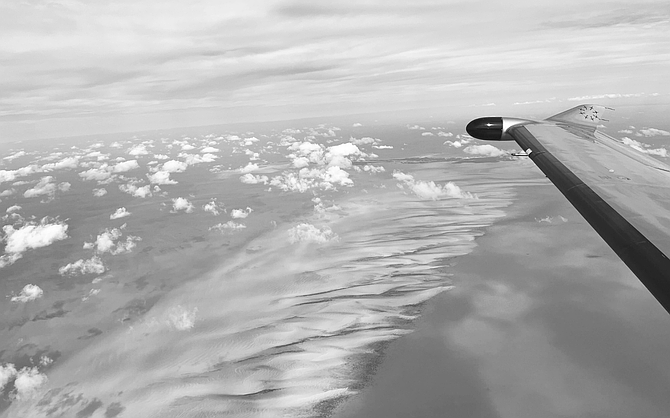
AN AIRLINE flies over the waters of The Bahamas.
The Bahamas Aviation, Climate and Severe Weather Network (BACSWN) has pledged that it is fully committed to a consultation process with airlines over proposed aviation charges.
The company also confirmed that the level of fees to be charged is still being finalised but reiterated that the widely-circulated figure of $775 is not valid.
A spokesperson said: “We have, on a number occasions, pointed out that this figure is completely out of date. We are happy to reconfirm that fact and put the record straight.”
BACSWN released its statement following remarks issued by the America for Airlines (A4A) organisation, which represents companies including Delta, American, United, and JetBlue.
The airline representative body did not specifically reference the $775 figure but it is widely believed it lay at the heart of their statement.
They said: “A4A member airlines have long questioned the legitimacy of overflight charges imposed by the Bahamas Air Navigation Services Authority (BANSA) for air navigation services that are already provided by the U.S. Federal Aviation Administration (FAA). We now have strong objections to a new unjustified fee the Bahamas Aviation, Climate and Severe Weather Network Ltd (BACSWN) proposes to charge carriers for a service that is not being provided.
“Aviation charges should only be paid for services actually provided to users. The charges should be non-discriminatory, transparent and cover the true cost of providing the service.”
Without quoting any figure, A4A described proposed charges as “astronomical”.
In reply BACSWN said: “BACSWN agrees with Airlines for America (A4A) that aviation charges must be fair, transparent and tied to services provided. The proposed charging methodology is being developed around Article 15 of the Convention on International Civil Aviation and the International Civil Aviation Organization’s (ICAO) associated policies.
“BACSWN is committed to ICAO’s four key charging principles: non-discrimination, cost-relatedness, transparency and consultation with users. Before any charge for aviation meteorological services is introduced, BACSWN will consult airspace users and provide details of the proposed services, their costs and expected benefits, including potential operational efficiencies.
“BACSWN’s proposed aviation meteorological services are intended to provide timely, reliable weather information that helps aircraft operators make informed decisions across approximately 174,000 square miles of Bahamian airspace. The aim is to enhance aviation safety and efficiency while ensuring that any charge is consistent with ICAO policy and the Civil Aviation Authority – Bahamas (CAA-B) regulations.
On the question of fees, they added: “We reiterate that the exact level of fees has not been finalised. Considerable movement in market conditions, rescoping the project, cost modelling and business projections mean that previously circulated figures, including one of $775, are no longer relevant. For the record, we expect the number to be considerably lower and we will provide more detail on this in due course.
“We welcome a constructive discussion with airlines and other airspace users. Our goal is to improve the weather information available to pilots and operators, with a charging approach that is fair, transparent and open to scrutiny.”
Addressing the United Nations General Assembly in New York earlier this week, Sebas Bastian, Minister of Innovation and National Development called for advances in forecasting, satellite imagery, risk mapping and early-warning systems to become more accessible to small states, with countries also given the capacity to deploy and maintain them over time.
He also advocated stronger regional cooperation that would allow Caribbean countries to pool technical expertise and resources while retaining national control over critical decisions and accountability.




Comments
Use the comment form below to begin a discussion about this content.
Sign in to comment
OpenID