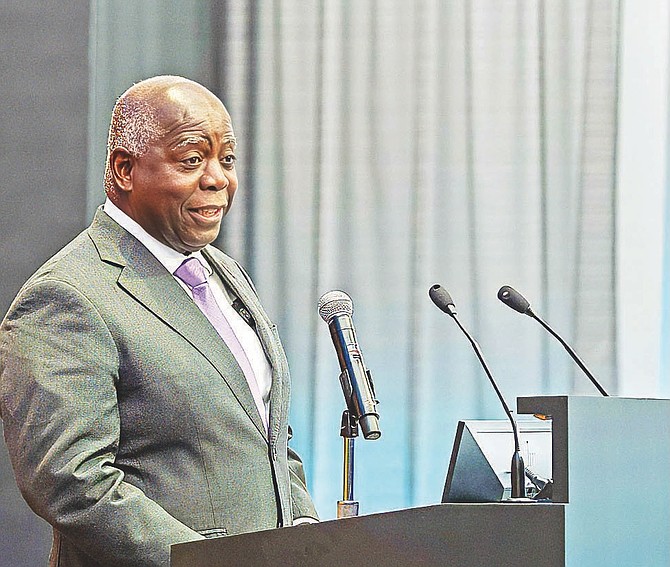
PRIME Minister Philip ‘Brave’ Davis speaks during the United Nations General Assembly in New York on September 25th, 2026
By LEANDRA ROLLE
Tribune Chief Reporter
lrolle@tribunemedia.net
PRIME Minister Philip “Brave” Davis warned world leaders on Friday that the international system is becoming one in which powerful countries can disregard rules that still bind smaller states, declaring: “International order, where rules apply only to the weak, is not order. It is a hierarchy.”
Addressing the 81st United Nations General Assembly in New York, Mr Davis mounted a forceful defence of the sovereignty of small states and argued that the global system is drifting away from the UN’s founding principle of sovereign equality.
He also called for an end to the trade embargo against Cuba, greater international support for Haiti, serious engagement with reparatory justice and stronger representation for smaller countries in global decision-making.
“It is not the small states who are dismantling the rules-based order,” Mr Davis said. “Small countries cannot dismantle a rules-based world, but we will be the first to be touched beneath its collapse.”
His remarks on sovereignty came days after the Davis administration was caught in an unusually public dispute with the United States over undercover Drug Enforcement Administration operations in The Bahamas directly to the US Justice Department.
Mr Davis did not reference that dispute in his UN address. However, Bahamas Ambassador to the United States Wendall Jones confirmed last week that a Bahamian delegation complained to US officials about what the government believes were “rogue” DEA operatives working in The Bahamas without permission. The concern emerged from the US investigation of accused drug trafficker Jonathan “Player” Gardiner and others.
US court filings revealed that the three-year investigation included undercover activity in The Bahamas and alleged that DEA operatives posing as members of a drug cartel met an unnamed Bahamian politician inside Parliament in October 2024 to discuss facilitating a cocaine transhipment operation. Mr Jones said the Bahamian delegation’s complaint concerned aspects of how the investigation was conducted, rather than the prosecution itself.
US Ambassador Herschel Walker sharply rejected the government’s position, dismissing the allegation that DEA agents had operated illegally as “fake news” and questioning why Bahamian officials were concerned that the United States had “helped to arrest a known drug trafficker”. Attorney General Wayne Munroe subsequently defended the complaint, saying American authorities would not accept Bahamian officers conducting similar operations in the United States without involving local law enforcement.
At the UN on Friday, Mr Davis warned more broadly against a return to an international order in which powerful countries dictate the affairs of smaller states.
“Treaties are being torn up,” Mr Davis said. “Institutions are being starved. Rules are giving way to deals, and the benefits of the deals go to whoever holds the most leverage.”
“For 500 years, the Caribbean was somebody's backyard,” he said. “We did not win our freedom to once again become somebody’s backyard.”
Mr Davis said the message being sent to small nations was: “Be as sovereign as we allow you to be.”
“A sovereignty that must ask permission is not sovereignty,” he said. “It is a lease. Our ancestors did not break their chains so that their children could become tenants.”
Mr Davis argued that while powerful countries might withstand the weakening of international rules, smaller states are more vulnerable to the consequences.
“When The Bahamas defends multilateralism,” he said, “we are not defending a bureaucracy. We are defending the only successful arrangement in which a nation of four hundred thousand people can stand at this podium as the sovereign equal of a nation of a billion people.”
He said the answer was not to abandon international rules but to ensure they bind powerful countries as firmly as smaller ones.
“Every rule you break today is a rule you will need tomorrow,” Mr Davis said. “Every institution you starve is one you will one day call upon. Every small nation you abandon is a crisis you will one day inherit.”
He said defending international rules was “not a favour to the small; it is an insurance for the strong”.
Mr Davis also used Haiti as an example of the consequences when a small nation's sovereignty is not respected.
He highlighted Haiti’s history as the first country to achieve freedom through a slave revolt successfully but said that victory came at an extraordinary cost.
“For that act of courage,” Mr Davis said, “it was made to pay.”
He said Haiti was compelled in 1825, under the guns of a foreign fleet, to compensate its former colonisers for its freedom and spent more than a century and a half paying that compensation.
Mr Davis called on the UN Security Council to renew its mandate and provide the gang suppression force in Haiti with the resources needed to achieve results while respecting Haitian sovereignty.
He also pointed to CARICOM’s Ten-Point Plan for Reparatory Justice and called on countries that profited from slavery to seriously engage with reparations.
“We call on the nations that profited to engage seriously with reparatory justice,” Mr Davis said, “truth, apology, restoration and development.”
On Cuba, Mr Davis reiterated The Bahamas’ call for an end to the trade embargo and appealed for Cuba’s removal from the state sponsors of terrorism list and the lifting of the fuel blockade.
“We call on all states to respect Latin America and the Caribbean as a zone of peace,” he said.
Climate change also featured prominently in the address, with Mr Davis warning that The Bahamas could not confront rising sea levels alone.
He said the loss and damage fund exists but argued that a power shift is needed to make it operational and effective.
Mr Davis also announced The Bahamas’ endorsement of the Declaration on Sea-Level Rise, which affirms “that our statehood, our boundaries and our seat in this Assembly will not be washed away by the sea.”
He also turned to the growing economic and political significance of personal data and artificial intelligence, warning against a future in which small states merely supply data to systems designed elsewhere.
“The old empires took our lands, plundered them and renamed them,” Mr Davis said. “The new ones seek to take our data, and hand us back a picture of ourselves, one we did not paint.”
He argued that people whose lives and histories are being mined should have a say in where their data is stored, who uses it and on what terms.
Mr Davis said artificial intelligence should understand local languages, respect national laws and reflect the lives of people outside the wealthy North.
“In this modern age,” he said, “are we expected to be simply the unquestioning suppliers of data, or can we not rightfully expect to participate in processing our own data so as to refine it, govern it and profit from it?”
He also backed greater involvement by smaller states in setting the rules of the digital age and publicly supported Stephen Bereaux’s nomination for Deputy Secretary-General of the International Telecommunication Union.
Mr Davis announced that The Bahamas intends to seek a seat on the UN Security Council for the 2032-2033 term, saying the country does not intend to sit quietly but wants to help change the status quo.
“Five nations still hold a veto over the peace of one hundred and ninety-three,” he said. “Most of the nations in this Hall did not exist when that arrangement was made. None of us was asked.”
“An institution that cannot reform itself cannot hope to reform the world.”
Mr Davis said the issue ultimately comes down to whether international power is exercised with legitimacy.
“Power without legitimacy is not order,” he said. “It is control. And a peace kept only by the powerful is not peace. It is permission.”




Comments
bahamianson 7 hours, 37 minutes ago
Disregard rules? Wow! Astonishing!!! I can’t trust or believe a word that is said.
whatsup 6 hours, 1 minute ago
BUT SMALL NATIONS CAN DISREGARD RULES?
licks2 5 hours, 50 minutes ago
Do yall ever read anything before talking so much dumb shit?? Read Bahamas Read!!
hrysippus 4 hours, 49 minutes ago
The years of relative peace may be over; Ukraine, Iran. & Venezuela all indicate that anew reality is facing this country. We have enjoyed are years of plenty, and mostly squandered the riches thereof, now come the years of famine. Best learn how to fish and grow corn again.
Sign in to comment
OpenID